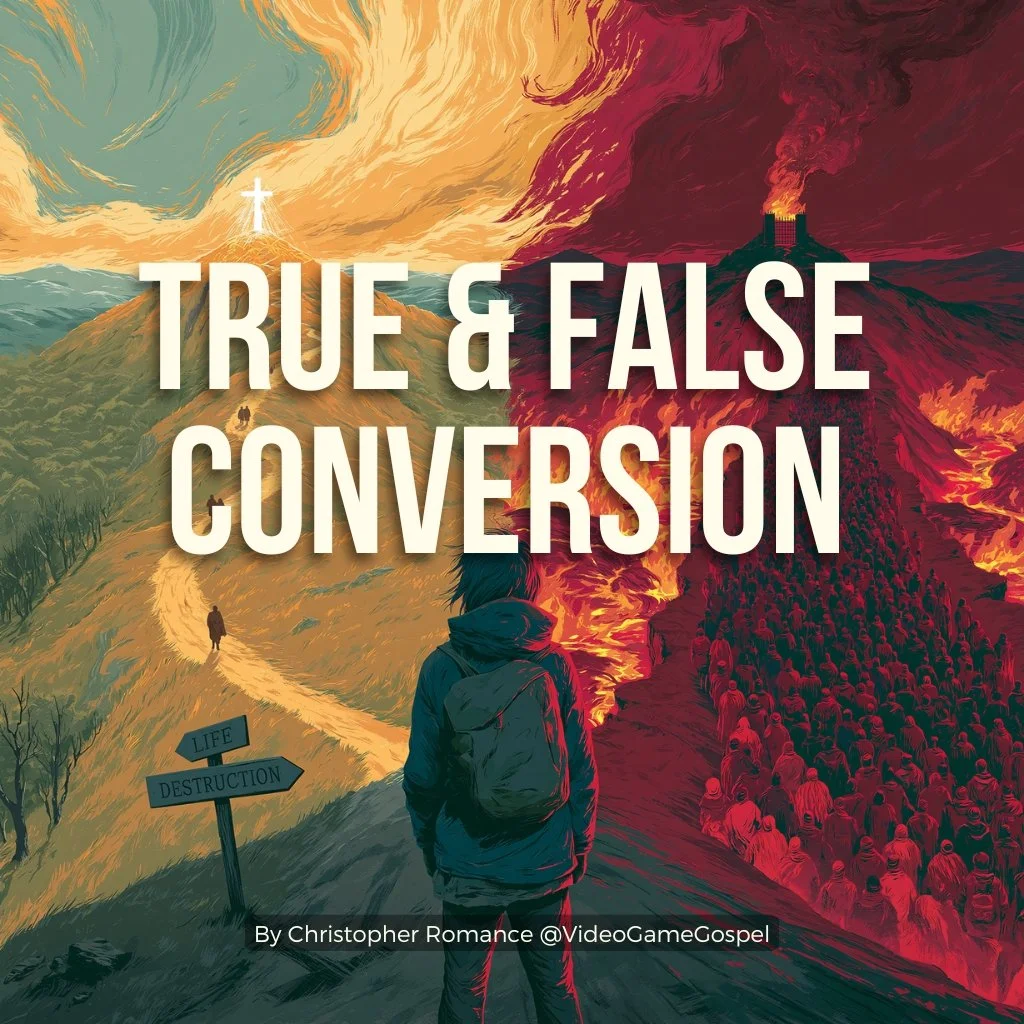
TRUE & FALSE CONVERSION

Table of Contents
Table of Contents
PART I: INTRODUCTION
In this teaching, we will be examining the Biblical doctrine of True and False Conversion. We will look at it from multiple angles, and in the end share a collection of Biblical Examples Jesus gave to separate the false converts from the true. The purpose of this teaching is both self reflection, and outward identification.
Helping you discern for yourself if you are in the faith (2 Corinthians 13:5), and for others, to see the need to preach to them the Gospel, should they not be truly saved.
For a full list defining the terms we use throughout, there is a heading at the bottom of this teaching about what a word means for us. This is where you will find clarification about what we mean when we use certain words.
The Matter At Hand
Now regardless of what one believes, If you call on the name of Christ, you must align yourself to the Bible, since afterall, what we understand about Christ comes from that very same Bible, and is alone the discerner of the thoughts and intents of the heart (Hebrews 4:12) and is given by inspiration of God to make us perfect and thoroughly furnished unto good works (2 Timothy 3:16-17). The Bible is the source of all truth, especially as it pertains to matters of doctrine and belief. When it comes to following the Bible, it is not up to us to follow just the parts we like, or the parts that fit our persuasions, but the whole host of it, especially the parts that condemn our beliefs.
In the Bible we have example after example, warning after warning, and command after command and it can come as a shock that many of the core doctrines of scripture are a great mystery to the professing Christian world. Many pastors, teachers, and elders fail to grasp the very core doctrines constantly repeated throughout scripture, despite the numerous mentions of them and how they are clearly taught. Some doctrines which are contended against, cannot be logically argued against in truth, nor are they particularly difficult to get to the bottom of and understand. Yet, there are many things that are hard to be understood, which they who are unlearned and unstable wrestle against (2 Peter 3:16).
The issue is, regardless of these commands, one cannot accept, know, or understand them, until God grants unto them understanding (Matthew 11:25, Job 32:8, Luke 24:45, 1 John 5:20). That understanding is only granted when the Lord God deems it so, and this seems to always align with the heart posture of the person seeking these answers. For someone who is living in sin, or otherwise is prideful, these simple truths might as well be written in an ancient long dead language, completely and utterly inaccessible to them. It is a wonder observing this, being on the other side of it, and that is not to speak in a prideful tone, but rather in a tone of humility. Knowing that the gate and access to these things, starts with a heart debased, and of true humility before God, fully repentant for one's own sins, and seeking nothing but Christ in one's life.
I heard a pastor once ask a group of men what they were hopeful for. One by one men pointed to earthly things of their gain or pleasure, whether it be simple things like farming, or riding motorcycles across the country. A few men had to say that their hope was in their loved ones coming to know the Lord. But to this observer, it was sad I stood alone in my conviction to live for Christ, and die for Him also, as my only hope and consolation for life. Sadder yet, is after I had spoken these things, the responses continued antithetical to Colossians 3:1-4 which reads:
“If ye then be risen with Christ, seek those things which are above, where Christ sitteth on the right hand of God. Set your affection on things above, not on things on the earth. For ye are dead, and your life is hid with Christ in God. When Christ, who is our life, shall appear, then shall ye also appear with him in glory.”
If the hope of our heart is in anything but those things which are above, and not on the Earth, we will always be Earthly and carnally minded. Only a heart that is truly set out for Christ, wanting nothing but the Lord, will ever be able to comprehend the deeper things of God.
One might claim that they are indeed right before God. But our position before God is not when you self affirm you are right before God, but when God sees your heart is right before Him. In accordance with His scripture. For our hearts are deceitful above all things, and desperately wicked (Jeremiah 17:9) and there is a deceitfulness to sin that blinds us (Hebrews 3:13) that requires daily exhortation to be revealed. No, It is God that searches men's hearts, and his Word is that tool which discerns the thoughts and intents of the heart (Hebrews 4:12). The same word we shall use today to do that discerning.
In fact all things of God in varying degrees can only be understood by a heart that truly belongs to God, in which God opens their eyes of understanding to know truth (Colossians 1:26, Ephesians 3:4-5, Romans 16:25, 1 Corinthians 2:7). It comes from a love of the truth: so as to be saved (2 Thessalonians 2:10).
One does not grow in wisdom, understanding, and truth, until their heart is truly repentant, truly contrite and a spirit that is broken before God (Psalm 51:17). Then God gives unto us understanding, wisdom, and knowledge.
Yet many will hear the words of Christ, have access to the scriptures, fill their mouths in prayer and in song with holy words blessing the Lord, and never be known to Him. As Matthew 7:21-23 says
“Not every one that saith unto me, Lord, Lord, shall enter into the kingdom of heaven; but he that doeth the will of my Father which is in heaven. Many will say to me in that day, Lord, Lord, have we not prophesied in thy name? and in thy name have cast out devils? and in thy name done many wonderful works? And then will I profess unto them, I never knew you: depart from me, ye that work iniquity.”
Likewise Jesus also said in Luke 13:24
“Strive to enter in at the strait gate: for many, I say unto you, will seek to enter in, and shall not be able.”
This ought to be frightening to many. The singular decision one must have, is to forsake all. All things, all hopes, all people, houses, or brethren, or sisters, or father, or mother, or wife, or children, or lands, for His name's sake, for Christ our Lord. (Matthew 19:29)
Many more such words are given by Christ and the Apostles. In fact the Bible is filled with this very thing. Yet how many people will go to the grave thinking themselves to be saved, only to find out that by their works they denied Him (Titus 1:16). And if you deny Christ, He shall deny you before the Father (Matthew 10:33-39, 2 Timothy 2:11-12).
Many teach that all one must do to be saved is just believe. Yet they ignore all of the words of Christ, and all of the words of the Apostles that spoke contrariwise. They themselves teach error and do sin, committing the very damnable heretical acts spoken of in 2 Peter 2. They desire to be teachers of the law, not knowing what they are saying or what they affirm (1 Timothy 1:7).
So while others blabber about, teaching “belief only”, with all sins allowed, refusing to repent, and having no semblance of the Holy Spirit in their lives. We are faced with an epidemic, where there are billions of professing Christians worldwide, with a statistical majority having a form of godliness but denying the power thereof (2 Timothy 3:5-7). What is that power of godliness? It is not worldly power, and it is certainly not spiritual wizard powers of the Bethel Schoolof witchcraft and wizardry, but it is the power of godliness itself. Which is a turning from sin, to living in holiness, by the product of the heart that is sold out entirely to God.
The purpose of this teaching is two fold, to cleanly and thoroughly establish the doctrine of true and false conversion for the express purpose of equipping saints to recognize it, preach it, and save some. And two, that someone reading this, may in fact recognize in themselves the need to truly repent and become born again, not by the works of men, but by the word of God (1 Peter 1:23).
Preaching From Experience
For over 17 years of my life I professed to be a Christian, but the entire transcript of my life until my moment of true conversion would have revealed my life did not belong to God at all. Instead, I lived with countless sins, while professing the name of Christ. It wasn’t until I truly repented, in a moment of desperation and despair, seeking to take my life, that I acknowledged fully my sin towards God, and as though ripping off a limb I loved, I forsook my sins before God and surrendered to Him.
For 17 years I blabbered about, not knowing what the Scriptures meant or said, “speaking in tongues”, “casting out demons” yet my life, should I have died before my conversion, would have been the condemning evidence for my everlasting stay in the fire of Hell. Where the worm dieth not, and the fire is not quenched (Mark 9:43-50)
My life was a sham, I named the name of Christ, but was indeed His enemy (James 4:4). Yet God had mercy on me, and when I prayed in that moment of desperation, moments from seeking to end my life, and truly repented, He saved me. Praise the Lord. For I was a wretch of wretches.
So when I write on this subject, I am not writing as someone who went to school and was told what to believe and why. Who received my training from men and not from the Holy Spirit (Galatians 1:11-12). Nor am I someone who heard someone preaching this and said “Yeah, I like that and agree and now that’s what I teach”. Instead I am someone who is writing as one who has lived on both sides of the faith. A false convert made born again. I say you must repent, turn from sin, forsake all that you have, not because I think it to be so, but because I have lived it, and learned it from the Holy Spirit through His Word. Jesus made it abundantly clear, providing over 12 examples of it in the Word.
I lived as a false convert for 17 years of my life. Having my understanding darkened, being lost still, professing Christ, yet by my works denying Him (Titus 1:16). I know what it is to claim Christ, yet not know Him and not be known by Him (Matthew 7:21-23)
I write this teaching with hope, and in love, that there is someone out there, who is in the exact same position as I was. Who loves their sin, and this world, more than God, and has yet to truly repent, and belong to the Father. Jesus quoted the prophet Isaiah in Matthew 15:8-9 when he said:
“This people draweth nigh unto me with their mouth, and honoureth me with their lips; but their heart is far from me. But in vain they do worship me, teaching for doctrines the commandments of men.
And Isaiah 29:13 says
“Wherefore the Lord said, Forasmuch as this people draw near me with their mouth, and with their lips do honour me, but have removed their heart far from me, and their fear toward me is taught by the precept of men:”
I submit to you that the vast majority of professing Christians, are not truly saved. This is primarily because scripture makes this abundantly clear and many are just like I was in my former conversation of life. I had never heard the Gospel preached to me, and I had yet to understand it and apply it. Jesus said in Luke 13:24
“Strive to enter in at the strait gate: for many, I say unto you, will seek to enter in, and shall not be able.”
The people striving to enter the strait gate are not the ones walking down the broad path. They are professing Christians, who have yet to enter into the gate. The toll is simple, repent and believe, but how great, how unreachable is that toll to pay, for a heart that loves sin more than God.
So then, let us examine this doctrine, and furthermore, may you examine yourself, to see if you are in the faith (2 Corinthians 13:5) and with fear and trembling work out your salvation (Philippians 2:12).
PART II: SCRIPTURAL PROOF OF TRUE AND FALSE CONVERSION
This teaching would be entirely incomplete without bringing to bear the many parables Jesus gave us about this very thing. While we have indeed covered many scriptures that already prove the point. We have yet to bring the full weight of scripture to bear. We are going to examine the following list of scriptures:
The Wheat and the Tares (Matthew 13:24-30)
The Good and Bad Fruit Trees (Matthew 7:15-23, Matthew 12:33, Luke 6:43-45)
The Two Foundations: Rock and Sand (Matthew 7:24-27, Luke 6:47-49)
The Wise and Foolish Virgins (Matthew 25:1-13)
The Parable of the Talents (Matthew 25:14-30, Luke 19:11-27)
The Sheep and the Goats (Matthew 25:31-46)
The Good and Bad Fish (Matthew 13:47-52)
The Seed Sower (Matthew 13:18-23, Mark 4:13-20, Luke 8:11-15)
The Pharisee and the Tax Collector (Luke 18:9-14)
The True Vine and the Branches (John 15:1-8)
The Unforgiving Servant (Matthew 18:23-35)
The Lukewarm Church at Laodicea (Revelation 3:14-19)
But before we examine each of these passages of scripture, let’s first explain what we mean by true and false conversion.
True and False Conversion Biblically Explained
It is obvious that the Bible speaks about salvation as something you either have or do not have. I doubt any professing Christian would argue that singular fact. Even for the Universalist, who believes all will be saved, they recognize that not all are currently saved. This brings into question as to what do we mean by “saved”
The shortest definition I can muster of “what is salvation”: is a state of being in which a person will ultimately be with God in the New Heavens and the New Earth. From the moment of true conversion, to their death or rapture, they keep and are kept on the path towards ultimate salvation. Salvation is interesting, because it has a temporal effect, while being effectively eternal. However, salvation in the logical sense, is being saved from something. What is that something? None other than sin and death. So if a person is saved, they are then saved from their own sin and death. But we are not in Heaven as of yet, we are not with God in the fullest sense as we hope and long for, so what is it that we have? Sure temporally we have the effect of the Holy Spirit and the word in our lives, we have been born again, made a new creature, but that is not to say we are yet fully translated to the fullness of the promise. Therefore, while we can say we have salvation and wait for that hope (Romans 8:20-25). We have not been translated into the eternal state of that salvation as of yet. Hence the need to endure and not apostatize into returning to a life of sin or through wanton false teaching (2 Peter 2, Hebrews 6:4-8).
When we speak about true and false conversion, we are referring not to just the binary state of being saved or not, as in the case of a worldly person, or an atheist who rejects God, compared to a truly born again Christian. But rather we speak of a subset of people, who accept Christ on the surface with a mental acknowledgement, but their hearts are far from him. The shortest, most crude and succinct definition, is a person who loves sin in their heart, and is not surrendered to God, all the while acting the part. This is true and false conversion.
Christ warned explicitly in multiple places, that there would be many who would seek to enter in the strait gate, and not be able such as in Luke 13:24. In Matthew 7:22-23 Jesus made it clear that many will even go so far as doing works in His name, prophecy in His name (which is another word to proclaim or preach), and to do many wonderful works in His name. Even to the degree of casting out actual demons in His name. Yet the charge against them is that they are workers of iniquity, who Christ never knew. These are not atheists, muslims, or people who openly deny Christ, since who does works “in His name” but those who claim to follow Him? These are people who literally did much of what most Christians cannot even say they have done today! Such as simply preaching the Gospel to their coworkers or neighbours. Yet these very people, who have done more than what most modern Christians have done, are still denied entry into heaven, being completely barred for the singular fact that they worked iniquity, or in other words, they lived lives of open or secret sin, yet claimed to serve God and did works in His name.
The Apostles themselves warned of this in 2 Timothy 3 and 2 Peter 2. Paul himself warned in Acts 20:28-31 with tears, night and day for a space for 3 years warning that wolves would enter in not sparing the flock. Warnings included mentioning how people would be ever learning but never able to come to the knowledge of the truth (2 Timothy 3:7) that they would have a form of godliness but denying the power thereof (2 Timothy 3:1-9), that there would be wells without water and clouds carried by a tempest (2 Peter 2:17-22), that they would withstand the truth, that they would wrestle against the truth of scripture and bring to themselves damnation (2 Timothy 3:7-9, 2 Peter 2).
Jesus Himself warned all of the churches where they had need to repent throughout Revelation and that all liars will have their part in the lake of fire (Revelation 21:8) as it says also in 1 Corinthians 6:8-11.
John in 1 John 3:15 told us that if someone hates their brother they do not have eternal life abiding in them.
And there are many more verses to draw from that speak on this very thing. The fact that this is so widely unknown, or misunderstood is both a direct result as to why many will strive to enter and not be able, and also as a result of it.
This Is Your Charge
In other words, people who ignore these verses, or who are unsaved and cannot understand or even follow them, even such verses as 2 Timothy 2:15, who live with sin, and wrestle against scripture (1 Timothy 1:7, 2 Peter 3:16), and do not teach this very widespread remarkably consistent and inarguable biblical doctrine: are thus because they themselves are often the ones striving to enter the strait gate, and will not be able. They are both the cause, and the result of false conversion.The blind leading the blind. Blind men, destitute of truth promoting other blind men to lead them in untruth, altogether leavening and cancering the whole lump. Yet God preserves a remnant always; Praise the Lord.
The singular separator from the true and false converts is this: a heart that is truly, and utterly sold out to God in full, true, and unquestionable submittance to Him. Being abased, and having a broken spirit and contrite heart (Psalm 51:17, Matthew 5:1-12)
And this is why the Gospel must be preached in full. Not forsaking the weight of the Law, nor the mention of Hell and fire. Too many a weak and cowardly pastor, elder, or lay person, has been directly responsible for not preaching the Gospel unfeigned, either for fear of men, or for fear of loss of relationship, as though they think through soothing pacification of relational love a person will arise from their slumber to see the fire which creeps towards their deliciously comfortable bed.
What use is it, to soothe a man about to perish to stay in his bed, lest he gets mad at you. Would not rather his arousal in anger be better to spot the flames then to keep your evil soothing of his comfort until the flames consume him at last? I would rather rouse 1000 men in anger against me, only for some to catch a glimpse of the fire about to consume them, then for my whole life pacify men in their beds to theirs, and my own destruction.
Therefore, rise up yourself. Teach what is true, no matter the cost, for their soul, and indeed your own, for both are at eternal consequence with each breath that is drawn.
1. The Wheat And The Tares Parable
Jesus Christ taught in Matthew 13:24-43 that there would be tares sowed among the wheat. In the parable Jesus explains that the wheat is that which God has sown, and the tares are that which the enemy has sown. The angels are instructed not to pluck up the tares with the wheat lest they remove some of the wheat with them.
This indicates that the very removal by force of the tares, can cause such a disturbance that true wheat is harmed as well. So the prescription given by Christ is to let them grow together and let God sort it out in the end. Here we have a view of salvation as a whole, and the coming judgement of God where the wheat will be separated from the tares in the final judgment of mankind. The wheat are truly born again Christians, and the tares are everyone who is not wheat.
From an analogical point of view, wheat and tares have some interesting features that are spiritually remarkable. Both the wheat and tares in the early stages of development look practically identical. However, when mature, the tare, (also known as a darnel plant), is dangerous to most animals. Humans eating it become nauseous, dizzy, and can have GI upset. Many other animals likewise can get ill from eating it. In contrast, wheat is nourishing to a much wider array of animals. When wheat grows, it starts as a grass, grows into a budding stalk, and eventually becomes a long stalk with equally spread seeds that bows under its own weight, almost as if it is a humble plant in perpetual bowing. In contrast when a tare grows, it starts as a grass like wheat, grows almost identically like wheat, but when it reaches maturity with its non equally spaced seed formed as a zig zag pattern, it does not bow. Instead it stands tall and proud. Almost as though the heart position of the falsely converted is proud, instead of humble (James 4:6-8).
Wheat bows under the weight of its seeds, the good fruit it produces is healthy for others but the tall proud tares fruit is poisonous for many. It is no surprise that Christ who is God used a perfect example in this particular parable of true and false conversion.
Later in the passage, Christ gives us the correct interpretation. He explicitly identifies the field as the world, the good seed as the sons of the kingdom, and the tares as the sons of the wicked one. The doctrine then stands under the premise that there are only but two types of people in the world. The saved, and the unsaved. This alone does not conclusively prove true and false conversion, but taken in conjunction with verses already given, and more that are to come, we can fold this parable as applicable nonetheless.
Separation Now and Then
Now, It is important to know that the context of this is that final judgement of God, and is not related to the various commands we have to mark and separate from false teachers or disobedient brethren (Romans 16:17-18), to not eat with those who are sinning openly (1 Corinthians 5:11), or to not have company with those who walk disorderly (2 Thessalonians 3:6-14). The church discipline given in Matthew 18 is a good example of our need to remove those who refuse to repent and walk in sin. Verses like 2 Timothy 4:2 that tell us we are to rebuke, correct, and exhort, even daily as it says in Hebrews 3:13. The purpose of separating disobedient Christians from the assembly of true believers is twofold, one is to cause shame that leads to repentance (2 Thessalonians 3:14-15, 2 Timothy 2:24-26) and the other is to protect those within the Church. Oftentimes rebuke acts as a tool which either softens the impenitent heart in sin causing their repentance, or it hardens them in their sinful ways thus solidifying them on their path to Apostasy. We hope for the former, and have grief at the latter.
It was once told to us in our ministry that if we “major in the minors” we will undoubtedly shrink our circle to a very small few. At the time, this unwise counsel was given as though it is in error to do so. Yet doesn’t the Bible command exactly that? Are we not called to contend for the faith (Jude 3:1) to hold fast (2 Thessalonians 2:15), and to preach sound doctrine (2 Timothy 4:1-4) for the express purpose of perfecting the body of Christ (Ephesians 4:11-16)? Could it be that because weak and cowardly men who love the high seat and praises of men (John 12:43, Jude 1:16) refusing to obey the word is in part the cause of the poor state of the church today? Furthermore, where in scripture is it given that we are to heed unto only what is “major” and ignore the so-called “minor” doctrines? Does not the scripture make no such distinction, but instead unilaterally teaches all doctrines equally? Granted if any doctrine is primary it is true and false conversion, or making sure one is truly saved first before anything else, yet besides the doctrine of salvation, where are we commanded to ignore the deeper doctrines? Hebrews 6:1-3 actually encourages the opposite, saying “Therefore leaving the principles of the doctrine of Christ, let us go on unto perfection; not laying again the foundation of repentance from dead works, and of faith toward God, Of the doctrine of baptisms, and of laying on of hands, and of resurrection of the dead, and of eternal judgment. And this will we do, if God permit.” Instructing us to not major in the “majors” but to actually go on into perfection.
Therefore we must understand that while separation of the wheat and tares is speaking about a different separation come the final judgement of God, it is to say nothing about church discipline, or about letting the tares/wolves and false prophets into your church but rather that in the end, the Angels will be sent to sort out the false from the true.
This is a theme that is repeated amongst many of the parables Jesus gives in this wise. There is a time for growth, a time to repent, and ultimately our time is up and our choices will be what they were eternally so (Revelation 22:11). Practically this means the true will remain with you and the false will be removed (1 John 2:19). But take care that you are not a gathering of the false, in which God removes the true from you, while you being none the wiser, shamefully beating your chest in pride thinking you are the true, when by your works, belief and doctrine, you deny Him (Titus 1:16).
2. The Good and Bad Fruit Trees
In Matthew 7:15-23 Jesus gives us stern warning to “beware” of false prophets, which come to us in sheep’s clothing, but inwardly they are ravening wolves. That is the immediate context of the following parable, that we are to beware false prophets that look like sheep.
In other words, those who play the part of Christians, but are not Christians indeed. Jesus tells us directly to “beware” of them, or in other words diligently watch out for them. Instead of just noting that they exist, we are told to be proactively searching for and examining the fruits of those in our midst. This is entirely missed in the modern church, with doors flung wide open for anyone to come in. Pews being full of men, women and children, who are superficially acquainted while being profoundly unknown to one another. It is this openness, and lack of diligent looking for fruits that is in part the cause of the atrocious sins in the Church, and falls on the heads of those who facilitate this sort of gathering, contrary to the biblical model.
He then declares that the way in which we will know them from one another, stands upon their fruits. He asks the rhetorical question, “Do men gather grapes of thorns, or figs of thistles?” which gives us two interesting pieces of information. One is that clearly the fruit is important, but the other is the type of tree itself and how the fruit and the tree are correlated one to another. Thorns do not produce grapes, and thistles do not produce figs.
Jesus then declares that a “good tree” can only bring forth “good fruit” and a “bad tree” can only bring forth “bad fruit”. The tree always matches the fruit. There is always a direct correlation between the person, and the acts that they do.
Notice how Jesus first starts by telling us that there will be wolves dressed as sheep? It would be quite easy to dismiss this parable as people of the world, and people of God if it were not for verse 15 telling us that the outside cover does not always match the inward state of someone's being. Howbeit it otherwise that they appear as sheep, but inwardly are ravening wolves? The very next sentence is “Ye shall know them by their fruits”
He then warns in verse 19 that “Every tree that bringeth not forth good fruit is hewn down, and cast into the fire.” giving us a final reminder that it is by their fruits we shall know them.
This necessarily involves testing the spirits to see if they are of God like we are commanded in 1 John 4:1.
What Are These Fruits?
A confusion often emerges as to what exactly Jesus meant by “fruit”. Well we already know the tree and the fruit are important to observe, and from 1 John 4:1 we are to test them, but there are a few more verses we can use to shed light on the matter. First in Ephesians 5:9 we are told:
“(For the fruit of the Spirit is in all goodness and righteousness and truth;)”
So any fruit, if it be true fruit of the Spirit in someone's life, needs to be in all goodness, righteousness and truth. Second we can see from Galatians 5:22-23 the description of those fruits born by the Spirit:
“But the fruit of the Spirit is love, joy, peace, longsuffering, gentleness, goodness, faith, Meekness, temperance: against such there is no law.”
And this where the discerning can tell the difference between just a good act, and a true fruit of the Spirit. In fact one may line up the qualifiers in a row, and test the fruit of someone's life by those standards:
Does it contain:
All goodness
All righteousness
All truth
Is all of it in true:
Love
Joy
Peace
Longsuffering
Gentleness
Goodness
Faith
Meekness
Temperance
Or is the person, and their fruit antithetical to those qualifiers? Remember, these inwardly ravening wolves wear the sheep's clothing. They likely walk like sheep and talk like sheep too. The only way we can know is to examine their lives and test their fruit. This is why things like watching pornography, lying, or other sorts of sins are indicative of a heart that is not transformed by God and made born again.
The tree is the person, the fruit is their acts. An apple tree cannot produce anything but apples, likewise a poison berry tree cannot produce anything but poison berries. Thus we will know them by their fruits. And Thus true and false conversion is manifest once again in scripture by the parable of the good and bad fruit trees.
Finally in case one where to contend this is not about Christians, All we must do is read on. In verse 21-23 Jesus declares the following, making it unarguably about Christians. For the term “Lord, Lord” is an endearing term, and the ones Jesus says used it, prophesied in His name, cast out devils, and did many wonderful works, yet He will profess unto them, He never knew them, and commands them to depart. Lets read what Jesus says directly after telling us to examine their fruits in verse 20:
“Wherefore by their fruits ye shall know them. Not every one that saith unto me, Lord, Lord, shall enter into the kingdom of heaven; but he that doeth the will of my Father which is in heaven. Many will say to me in that day, Lord, Lord, have we not prophesied in thy name? and in thy name have cast out devils? and in thy name done many wonderful works? And then will I profess unto them, I never knew you: depart from me, ye that work iniquity.”
Let us make doubly sure then, we are not these ravening wolves in sheep's clothing, and to beware of them amongst us to one: preach unto them the gospel and two: remove them from us should they not repent.
3. The Two Foundations Rock and Sand
In the same chapter as the Good and Bad Fruit, Jesus Christ talks about those who built their foundation either upon the rock, or upon the sand as we read in Matthew 7:22-27 and Luke 6:45-49.
We see Jesus speak of two types of men; a wise man who builds his house upon the rock, and a foolish man who builds his house upon the sand.
The Foundation/Rock is Christ, the same rock and foundations spoken of Christ in many verses such as the head of the corner in Matthew 21:42 and Acts 4:10-11, and in 1 Corinthians 3:11-15 Jesus is the foundation that no other man can lay but Him.
The Sand is everything else. If you build upon this foundation any of your works, regardless of the type, and not on repentance and belief on the Lord Jesus Christ, you will fall, and great will be your fall.
The House is the works a man does, the manner in which he lives his life, his deed acts, and accomplishments for the Lord. Whether he builds with cheap things such as wood and hay, or costly things such as precious metals and gems. These are the manner and quality of our works for the Lord, whether in truth and suffering, or in concessions and compromise against godliness and truth.
Easy Believism Will Not Stand
Jesus gives us the determining factor of which of these people you are. He says “Therefore whosoever heareth these sayings of mine, and doeth them, I will liken him unto a wise man, which built his house upon a rock: And the rain descended, and the floods came, and the winds blew, and beat upon that house; and it fell not: for it was founded upon a rock. And every one that heareth these sayings of mine, and doeth them not, shall be likened unto a foolish man, which built his house upon the sand: And the rain descended, and the floods came, and the winds blew, and beat upon that house; and it fell: and great was the fall of it.” Or in short, those who hear, absorb, apply and do the things He said, are ones who build upon Christ. Not the ones who hear, absorb, and do not the things he said. Those build upon sand.
Thus we learn that it is not enough to simply hear, absorb and understand the commands of Christ. But to actually do them. The insidious doctrine of Easy Believism that teaches all one must do is “Just Believe” collapses under the weight of this passage. For how can Jesus claim that only the doers of His commands are safe while the disobedient are called fools who come to great ruin, if the only requirement was belief in solitude? It is a wicked, and perverse doctrine that preaches one must simply utter a few words and keep all manner of sin and still be saved. Repentance is a requirement which necessarily includes a turning from sin, for how can one say they have turned from anything if they are still neck deep in it? They lie when they say they have repented and yet still imbibe on their wretched sins.
We prove this point by looking to another false deceiver in Acts 8:7-25 who had captured a whole city, from the great to the least with sorceries. His name was Simon, who for a long time had bewitched the city, when Philip came preaching the things concerning the Kingdom of God and the name of Jesus Christ, many were baptized, men and women, and even Simon The Sorcerer himself quote “believed also” and was “baptized” in verse 13. Later in verses 18-24 Simon sees Peter and John give the Holy Spirit through the laying on of hands, and offers his money to purchase this Gift and Peter rebukes him saying “Thy money perish with thee, because thou hast thought that the gift of God may be purchased with money. Thou hast neither part nor lot in this matter: for thy heartis not right in the sight of God. Repent therefore of this thy wickedness, and pray God, if perhaps the thought of thine heart may be forgiven thee. For I perceive that thou art in the gall of bitterness, and in the bond of iniquity.”
Once again we see the same indictment that Christ gave, the fact that many would come in His name, and yet would be workers of iniquity. So was this Simon, who did believe, and was baptized, by the very Apostles, and still… His heart was not right in the sight of God, being in the gall of bitterness and in the bond of iniquity. In other words he had yet to repent of his sins, despite “Just Believing”
Many will point to the thief on the cross, that if we must do this and that then how could the thief have been promised heaven if he did none of it. He did not get baptized, he did not follow the commands of Christ since he died shortly after. This position reveals the heart, and shows that a person does not understand salvation.
The question is not whether or not the thief of the cross “did” do certain acts, but what “would” he do. You see, the thief had mere hours to live, yet had genuine contrition and repentance on that cross, knowing he deserved to be there, was guilty of his sins, and was condemned justly as a sinner. Yet he turned to the saviour begging for forgiveness and Christ saw His heart and granted him everlasting life. Should that thief have lived, I submit to you now that he would have been baptized, he would have obeyed the commands of Christ, and he would have made much of the name of Christ. Christ knows all things of a man and where his heart sits. He knows given the opportunity that that truly penitent man would have done all things to obey his Lord. And so it is with true and false conversion, it is of the heart, and of true repentance, not just belief alone.
How do I know this? Because the heart position that produces genuine contrition and repentance towards God, is also the heart position that would as much as I or anyone else who loves the Lord, do everything in their power to abandon this world, sin, and follow after Christ.
This is what Jesus is saying, about hearing and doing. If you truly believe it, if you are truly repentant, you are going to follow Christ and His commands, did not He say unto us in the very same parable in another place "And why call ye me, Lord, Lord, and do not the things which I say?” (Luke 6:46-49) and also in John 14:15 say “If ye love me, keep my commandments.”?
Therefore, ye shall know them by their fruits. If a man truly loves the Lord, he will hear Him and obey him, thus by fruits, by how and where they build, we know who they are. Be not just a hearer of the word but a doer as it says in James 1:22.
Build upon the Rock which is to say: Do the things which Jesus said.
4. The Wise and Foolish Virgins
In Matthew 25:1-13 Jesus gives us the parable of the wise and foolish virgins. In the parable there are 10 virgins, all with lamps, who went forth to meet the bridegroom. This particular parable is purposely given to describe the coming of the Lord as described also in Revelation. In ancient times, there was a waiting time where bridesmaids would wait for the arrival of the bridegroom. In ancient Jewish custom, weddings usually began in the evening with lamps lit at dusk. In the Parable Jesus comes at midnight, which is much further along than the bridesmaids expected. Very true to our own waiting for Christ to come. These bridesmaids were not passive in their function, their job was to announce the coming of the bridegroom with their torches lit, singing songs. In the parable the bridesmaids all slept, yet five were wise and five were foolish. The wise ones took oil in their vessels with their lamps and the foolish had no oil. All of them slumbered and slept as the bridegroom took much longer than they expected. Suddenly a cry is made that the bridegroom is coming!
All of the virgins arose, and trimmed their lamps, yet only the wise had enough oil to meet the bridegroom. The foolish ones in turn, begged for some of the oil from the wise, but the wise had only enough for themselves and could not spare.
The foolish virgins were told to go and buy oil, but as they did so the bridegroom came and those who were ready went into the marriage, but unto those who were foolish, the door was shut. And again we hear the term “Lord, Lord” and they demand the door be opened unto them, and they hear that same reply from earlier in the book of Matthew “I know you not.”
Understanding The Parable
This sobering story has many parallels to Jewish Wedding customs, the coming of the Lord, and true and false conversion. Taking a deeper look at the materials used in this parable we find a few items of note.
First we have The Virgins themselves. Virgins by nature are set apart, undefiled, pure in both a Biblical and a worldly sense. In Revelation 14:4 the 144,000 are those which “were not defiled with women, for they are virgins." Similarly virginity in scripture carries spiritual meaning of being completely devoted to God, uncorrupt in faithfulness to him. Israel for example is often described in terms of harlotry or adultery by the prophets such as we see in Jeremiah 3, Ezekiel 16 and 23, Hosea 1-3 when they turn from their pure devotion to false gods and idols. James 4:4 also describes love of the world as adultery against God. So the spiritual significance of these all being virgins is more than just coincidence. Christ is telling us these are those who are set apart, made clean, pure, as virgins are both physically and spiritually. Which indicates these are not those who were adulterers, or harlots, but pure. It is not a stretch to say that only Christ can make pure, and that these virgins were waiting on the Bridegroom. I submit to you, as with other parables, only those who believe in Christ wait for Him, it is reasonable then to infer these virgins waiting for the Bridegroom are all professing believers in God.
Second we have The Lamps and Oil, which altogether signify two things: One is that which shines brightly, and the other is that which enables the fire to burn. A lamp without oil is almost as useless for lighting the way as oil without a lamp. Jesus gives us the description of what the oil is by tying it to being prepared for the Bridegrooms coming. In the simplest rendering of the passage is then a readiness for His coming. Repentance, obedience, and a life lived for Christ. In contrast, the foolish virgins knew full well that Jesus or in this parable the Bridegroom was coming. Yet while guilty of slumbering too, they still had yet to prepare in the slightest.
When the Bridegroom comes at midnight, only those who are ready to meet Him are granted entry into what is the marriage feast of the Bridegroom. Those who were not ready, and had no preparation, no oil, no works, no merit of true obedience and repentance towards God, though wearing the same clothing, and set apart as the other virgins. They are not granted entry into heaven.
What was different? Were the wise virgins more virgin than the foolish virgins? Not from what we can see from the text, which altogether could not make distinction in those two things for both are virgins by nature. What was different, was not in the slumbering, nor in the possession of a lamp. But singularly, preparedness. In other words, they were slothful, lazy, and were not prepared for the coming of the bridegroom.
There is another group of people Jesus spoke of, who are cast into outer darkness, with weeping and gnashing of teeth, who as well were lazy and unprepared, who did not what was right in the eyes of God. We will examine these next.
5. The Parable of The Talents
In the very next parable following the Wise and Foolish Virgins, Jesus gives us the parable of the Talents. Found in Matthew 25:14-30 and in Luke 19:11–27. In this parable, Jesus describes “the kingdom of heaven is as a man travelling into a far country, who called his own servants, and delivered unto them his goods. And unto one he gave five talents, to another two, and to another one; to every man according to his several ability; and straightway took his journey.”,
In Biblical times, a talent was worth about 6000 Drachmas or Denarii, and in Matthew 20:2, Jesus establishes that this is what an average basic worker made in a day. Depending on the skill of that labourer, one could earn 1 to 3 denarius a day, sometimes more. 6000 Drachmas was the equivalent of about 20 years of working for the unskilled labourer, and that made up about 1 talent. In other words, a person earned maybe 4-5 talents in their life if they lived to 100 and started very early in their lives. The modern equivalent on one talent is anywhere between $350,000 to $500,000. Assuming the high figure, 5 talents was then 2.5 million dollars, 2 talents was 1 million dollars, and 1 talent was $500,000. Which in the parable was given sequentially to 3 different men.
The point has less to do with the actual value, and more to do with just how valuable a thing was entrusted to each man. Neither the one with only 1 talent, nor the man with 5 talents, had a small sum of money given to them by their master to steward well.
In the parable we see the master return, and reward each servant according to their use of his wealth. To the one who took his gift and built upon it much like the servant who built his house upon the rock, the Master says to the servant “Well done, good and faithful servant; thou hast been faithful over a few things, I will make thee ruler over many things: enter thou into the joy of thy lord.” This is said to both the servant who had 5 talents and made 10, and the other servant which had 2 talents and made 4. Yet to the one who had been given but 1 talent, he heard a very different reply.
This man was wicked and slothful, and by proxy of his own actions, he demonstrated he had no real measure of care or concern for the gift he received. Much like those foolish virgins who had no preparation, this man had received a great gift, yet had so little care for his master, and the gift, that he buried it in a hill.
When the master came to receive from his servant that great gift he had given, it would be only natural to expect that the servant had stewarded the gift of his master well and had honoured his master. Yet what is revealed is the slothful servant finds an excuse to not honour his master by trying to indict the master himself of his lack of need for the gift. The servant replies “Lord, I knew thee that thou art an hard man, reaping where thou hast not sown, and gathering where thou hast not strawed: I was afraid, and went and hid thy talent in the earth: lo, there thou hast that is thine.”
The servant knew the master reaps where he had not sown, and gathered where he had not strawed, yet this defense is really a guise, an excuse, to dismiss why he cared so foolishly for the gift.
The master replies with “Thou wicked and slothful servant, thou knewest that I reap where I sowed not, and gather where I have not strawed: Thou oughtest therefore to have put my money to the exchangers, and then at my coming I should have received mine own with usury. Take therefore the talent from him, and give it unto him which hath ten talents. For unto every one that hath shall be given, and he shall have abundance: but from him that hath not shall be taken away even that which he hath. And cast ye the unprofitable servant into outer darkness: there shall be weeping and gnashing of teeth.”
And cast is, that unprofitable servant into what is to be understood as Hell. You see because the gift is given with expectation from the master that regardless of his reaping and gathering where he has not sown or strawed, it has no bearing on the need to be profitable and diligent with the gift you are given. In the very least, taking the master’s talent, and putting it to the exchangers would have been more profitable for that servant.
His laziness, and unprofitability earns him his just reward, the gift is taken from him and given to the one who had made the five into ten, and that wicked and unprofitable servant is cast into outer darkness.
Notice the indictment is not just unprofitability, but is also that the servant was wicked. In this case we see that the unprofitability coincides with wickedness and is a result of it. We see the self same doctrine of true and false conversion repeated again, a separation from the true, to the false. One who is profitable to the master, and one who is not.
The Pattern Emerging From These Parables
These parables are not about the lost in the traditional sense, of those who do not call upon Christ. But rather each of these parables thus far have indicated that the servant, virgin, foundation builder, the tree and its fruit, and the wheat or tare all have knowledge of the Lord, and in most cases outrightly are claiming to be of Him.
The Tare pretends to be along with the wheat, the bad tree producing bad fruit has on sheep's clothing, the one who builds on sand heard the words of Christ yet did not do them, the virgins both waited for the bridegroom yet only one was ready and prepared with oil, and the wicked unprofitable servant was given the gift by the same master who rewarded the good and faithful servants.
Notice this also: The juxtaposed servants are the ones who were “good and faithful” against the “wicked and unprofitable” one. All of these parables indicate both the heart position of the person, and their conduct in life. Let's be the former.
6. The Sheep And The Goats
The very next parable in Matthew 25 which follows the Good Faithful Servants versus the Wicked Slothful one, is the parable of the Sheep and Goats in Matthew 25:31-46. The context of this parable is the Son of man coming in His glory with all the holy angels with Him. Eschatologically speaking, this is after the trumpet judgements and the bowls of God’s wrath mentioned in Revelation. In this moment, the final judgement for all mankind takes place. All the nations shall be gathered together, and the Lord shall separate them as sheep from goats. The sheep will be on his right hand, and the goats on the left.
The sheep shall hear the King saying:
“... Come, ye blessed of my Father, inherit the kingdom prepared for you from the foundation of the world: For I was an hungred, and ye gave me meat: I was thirsty, and ye gave me drink: I was a stranger, and ye took me in: Naked, and ye clothed me: I was sick, and ye visited me: I was in prison, and ye came unto me. Then shall the righteous answer him, saying, Lord, when saw we thee an hungred, and fed thee? or thirsty, and gave thee drink? When saw we thee a stranger, and took thee in? or naked, and clothed thee? Or when saw we thee sick, or in prison, and came unto thee? And the King shall answer and say unto them, Verily I say unto you, Inasmuch as ye have done it unto one of the least of these my brethren, ye have done it unto me.”
The goats on the King's left hand shall hear Him say:
“... Depart from me, ye cursed, into everlasting fire, prepared for the devil and his angels: For I was an hungred, and ye gave me no meat: I was thirsty, and ye gave me no drink: I was a stranger, and ye took me not in: naked, and ye clothed me not: sick, and in prison, and ye visited me not. Then shall they also answer him, saying, Lord, when saw we thee an hungred, or athirst, or a stranger, or naked, or sick, or in prison, and did not minister unto thee? Then shall he answer them, saying, Verily I say unto you, Inasmuch as ye did it not to one of the least of these, ye did it not to me. And these shall go away into everlasting punishment: but the righteous into life eternal.“
If someone is not considered a sheep, they are not granted eternal life and are instead cast into Hell. Those who are singularly defined as sheep, are those who did the works that accompany being born again. Remember the words of Christ which say “If ye love me, keep my commandments.” (John 14:15) and “By this shall all men know that ye are my disciples, if ye have love one to another.” (John 13:35).
The Pattern Emerges Again
The sheep are once again determined by their actions and fruit. Like the good and bad trees, or the wise and foolish virgins, or the good and wicked servants, all parables make distinction between the lives of the people being discussed. The sheep had great love for their fellow man, and took care of their needs as it says in God’s word in John 13:35 that all men will know we are His disciples by the love we have for one another. One who lacks love for his brothers or sisters in Christ, and is rather unconcerned and perhaps even hateful will find him or herself in the next group of people. 1 John 3:9-11 says
“Whosoever is born of God doth not commit sin; for his seed remaineth in him: and he cannot sin, because he is born of God. In this the children of God are manifest, and the children of the devil: whosoever doeth not righteousness is not of God, neither he that loveth not his brother. For this is the message that ye heard from the beginning, that we should love one another.”
Notice how 1 John 3:9-11 all three concepts in one place
Regenerated (born again): “Whosoever is born of God doth not commit sin; for his seed remaineth in him: and he cannot sin, because he is born of God.”
True and False Conversion: “In this the children of God are manifest, and the children of the devil” (directly related to the sheep and goats, wheat and tares, wise and foolish virgins, good and bad trees etc)
Fruit as Inevitable Evidence: “whosoever doeth not righteousness is not of God, neither he that loveth not his brother. For this is the message that ye heard from the beginning, that we should love one another.”
The sheep are not just hearers, but doers of God’s word and will (James 1:22, Matthew 7:21), and they love the Lord their God with all their heart, mind, soul, and strength and love others as themselves (Matthew 22:37-40). This is a key difference between goats and sheep, the sheep are servants (Matthew 23:11) the goats are not. Jesus told the goats to “Depart” that they were “cursed, into everlasting fire, prepared for the devil and his angels” and then he begins to list how they failed to obey God:
“For I was an hungred, and ye gave me no meat: I was thirsty, and ye gave me no drink: I was a stranger, and ye took me not in: naked, and ye clothed me not: sick, and in prison, and ye visited me not.”
When Jesus was hungry, thirsty, a stranger, naked, sick, and in prison they were nowhere to be found. They did not do the works that accompany salvation (Hebrews 6:9). In other words, while being pastors, or ministry leaders, or just a lay person, these people neglected the needs of the people that were considered the least of these.
While the entire parable expands to the broad scope of all nations being judged, it cannot be denied that those who are considered sheep are those who obeyed the commands of Christ, loved God and subsequently loved their neighbour. If one were to contend that the goats are strictly the lost of the world of all the nations, I would simply agree. Stating only that the lost includes not just the worldly ones and those of other religions, but even all those who claim Christ but are not of Him and, do the things he said (Luke 6:46-49)
Jesus made clear in the previous chapter of Matthew 7:21-23 that not even those who prophesied in His name, cast out devils, and did many wonderful works, who called him “Lord, Lord” “shall enter into the kingdom of heaven; but he that doeth the will of my Father which is in heaven.” Instead Jesus tells them “I never knew you: depart from me, ye that work iniquity.”. Therefore we can hardly conclude that the Lost are only those we deem lost, but rather that which the Father has determined are still yet lost, being workers of iniquity. 1 John 1:6 says “If we say that we have fellowship with him, and walk in darkness, we lie, and do not the truth:” and 1 John 2:9-11 says “He that saith he is in the light, and hateth his brother, is in darkness even until now. He that loveth his brother abideth in the light, and there is none occasion of stumbling in him. But he that hateth his brother is in darkness, and walketh in darkness, and knoweth not whither he goeth, because that darkness hath blinded his eyes.” and finally 1 John 2:15-17 says “Love not the world, neither the things that are in the world. If any man love the world, the love of the Father is not in him. For all that is in the world, the lust of the flesh, and the lust of the eyes, and the pride of life, is not of the Father, but is of the world. And the world passeth away, and the lust thereof: but he that doeth the will of God abideth for ever.”
Brothers and sisters, I submit to you, that the Bible is not at all silent about this issue. There is a difference between those whose hearts have been turned over to God and thus born again, and those that are not. We must learn to recognize this in our churches, family, and in the world that we may preach the Gospel. Looking for that fruit that becomes the evident token of their salvation (Philippians 1:28).
7. The Good and Bad Fish
Earlier in Matthew 13:47-52 we see Jesus describing the same sort of separation between those who are wicked and those who are just. In this passage He is describing how the Kingdom of Heaven is like casting a great net and pulling up all manner of fish, and those fish which are good are kept in vessels and those which are bad are cast away into the furnace of fire: there shall be wailing and gnashing of teeth.
In other words the good are kept and stored, and the bad are cast into the fires of Hell. This gives us stark and vivid imagery of the coming judgment should we be deemed a “bad fish”.
Now while the descriptive elements of what makes one a good or bad fish is not thoroughly explained, from what is explained, it is clear that the severing is dependent upon whether a person is deemed wicked, or whether they are deemed just.
This aligns with what we have learnt so far. The goats were ones who were wicked, who cared only for themselves and let others around them suffer. The ravening wolves and bad trees produced rotten fruit, and the tares had no good fruit either, and the slothful servant was morally bankrupt and devoid of anything to show for his great gift.
The common theme we witness in scripture is, the product of our life matters. Where things often get confused, is that the life of good works itself is what gains, maintains, or warrants salvation. This is opposite to the truth as salvation works in the other direction.
If someone is truly contrite with a spirit that is truly broken (Psalm 51:17), who has fallen upon the stone and is broken (Matthew 21:42-44), and has not the sorrow of the world but true genuine repentance (2 Corinthians 7:10) they will through the very nature of being born again have a life filled with good works. Much like how a good tree being planted cannot help but bear good fruit.
The Fruit, and Not The Root
That life of a heart transformed bearing good works, is not what gains, maintains, or warrants salvation, but the product of salvation itself working in them. Works are not the root of salvation, but the fruit of salvation. The cost, if any, is a person's true genuine repentance, being fully forsaken of this world and sin, in a following after God. Which in itself produces works of godliness, but is not founded in those works of godliness. I cannot say it any better than what God has already said in Ephesians 2:8-10
“For by grace are ye saved through faith; and that not of yourselves: it is the gift of God: Not of works, lest any man should boast. For we are his workmanship, created in Christ Jesus unto good works, which God hath before ordained that we should walk in them.”
There is a true saying that goes something like: Salvation begins at the end of the 18 inch journey from your head to your heart. Or in other words, salvation begins with a heart choice to repent and believe in God. It is not just acknowledging that He died for your sins, trusting in a prayer, while you continue to deny him with your works (Titus 1:16).
And so it is that many fill their heads with knowledge, but their hearts do not belong to God. It is in the surrender of the heart toward God, not in the knowledge of the mind, that a person is truly born again. The fruit that is produced from that inner surrender cannot be contained. In fact it would be harder for a person to contain their righteous zeal for God with works from a heart truly born again, than for the unrighteous man to muster but a single comparable fruit of the smallest most insignificant kind. For it is in that change of creation, that a man cannot but help in their obedience to God with fruit abundant to His name. For they have been transformed, the old man is dead and they yet live. How can a dead man bring life, or how can one that is alive be dead?
Do the dead walk, and the living lay deep in the ground?
If you are born again, the fruit of that change deep within is undeniable. Likewise, if a man be dead, so does his fruit bear record against him. This is why James taught what he did, professing that faith without works is dead.
James 2:14-26
“What doth it profit, my brethren, though a man say he hath faith, and have not works? can faith save him? If a brother or sister be naked, and destitute of daily food, And one of you say unto them, Depart in peace, be ye warmed and filled; notwithstanding ye give them not those things which are needful to the body; what doth it profit?
Even so faith, if it hath not works, is dead, being alone.
Yea, a man may say, Thou hast faith, and I have works: shew me thy faith without thy works, and I will shew thee my faith by my works.
Thou believest that there is one God; thou doest well: the devils also believe, and tremble. But wilt thou know, O vain man, that faith without works is dead?
Was not Abraham our father justified by works, when he had offered Isaac his son upon the altar? Seest thou how faith wrought with his works, and by works was faith made perfect? And the scripture was fulfilled which saith, Abraham believed God, and it was imputed unto him for righteousness: and he was called the Friend of God. Ye see then how that by works a man is justified, and not by faith only. Likewise also was not Rahab the harlot justified by works, when she had received the messengers, and had sent them out another way?
For as the body without the spirit is dead, so faith without works is dead also.”
8. The Parable of the Seed Sower
Jesus gives us an indepth look at what happens in the hearts of men when they hear the Gospel in Matthew 13:3-23. He does so through a parable that describes what type of men hear the word, and the result of it in their hearts.
Jesus often spoke in parables, so that “... in them is fulfilled the prophecy of Esaias, which saith, By hearing ye shall hear, and shall not understand; and seeing ye shall see, and shall not perceive:” (Matthew 13:14)
And in the self same place where Jesus utters these words, He gives us the parable of the seed sower. In Matthew 13:3-23, Jesus describes how a sower goes forth to sow seed. Later it is revealed that the seed is the word of the kingdom. Many have rightly discerned that this is the gospel message being preached, and that the ground in which the seeds fall is the hearts of men.
Jesus describes how the seed falls into four different types of soil, or to be understood as the hearts of men that hear the “word of the kingdom”.
The first, is the seed that is sown by the way side. The fowls of the air swoop down and devour the seeds up. Later Jesus explains that “When any one heareth the word of the kingdom, and understandeth it not, then cometh the wicked one, and catcheth away that which was sown in his heart. This is he who received seed by the way side.”
The second seed falls upon stony places, “where they had not much earth: and forthwith they sprung up, because they had no deepness of earth: And when the sun was up, they were scorched; and because they had no root, they withered away.” Jesus explains that this seed is “But he that received the seed into stony places, the same is he that heareth the word, and anon with joy receiveth it; Yet hath he not root in himself, but dureth for a while: for when tribulation or persecution ariseth because of the word, by and by he is offended.”
The third seed is described as having “fell among thorns; and the thorns sprung up, and choked them:”. Jesus describes this as “he that heareth the word; and the care of this world, and the deceitfulness of riches, choke the word, and he becometh unfruitful.”
Finally the fourth seed is that which “fell into good ground, and brought forth fruit, some an hundredfold, some sixtyfold, some thirtyfold.” Which Jesus describes as “he that received seed into the good ground is he that heareth the word, and understandeth it; which also beareth fruit, and bringeth forth, some an hundredfold, some sixty, some thirty.”
Only the fourth of all the seeds is truly saved, that one that bears fruit. All the others for various reasons turn away from God in the end. Whether it be the way side men whom the seed is caught away by the enemy, brought on no doubt by their overly beaten down path of their heart, with no room to receive the word or let it take root. Or it be the heart of a man who is that stony place, who though he responds to the Gospel, he ultimately casts it away for the hardness of his heart, with no root in himself, and when trials and tribulation comes, he abandons the message as quickly as he received it. Or it be the third seed sown among thorns, which the cares of this world, the deceitfulness of riches, choke out any and all fruit, and he becomes unfruitful.
And many there be which sit in the seats of the assembly, who have had their hearts choked out by the concerns of this world. Leaving the cross of Christ for idols, for money, for this world.
Salvation Explained Without Invoking Determinism
Now I must digress soteriologically to explain that the type of men spoken of here are not that way arbitrarily, nor are they divinely willed to be such. The stony heart which rejects the Gospel is both a result of their heart, and a just judgement for their impenitent heart, to be judged in their sins. Granted all men are lost before Christ, but each man that has Christ truly, has at some point surrendered to him. Therefore the heart is so, because the man is so, and the man is so, because he made a free will choice to be so.
Salvation is both a work of God to reveal sin and pierce the stony veil of the heart, and a choice by man to grab onto that glimmer of light that breaks through.
It might be explained that salvation looks like a man trapped in a dark stony prison, a cave full of greed, covetousness, pride, envy, murder, hate, lust, and evil. The man himself is not those things, but rather consumes them willingly. The word, the law, and the message of Christ, is like rocks being pelted from above this stony prison, whereby cracks begin to form. As these cracks form, light begins to break through.
Like a golden ray of light reaching down into a dark and devilish place is the gospel message to the soul of a man who is lost in his sins. And there is but two responses:
The man can turn, grab hold of this light, and watch as the walls and ceiling begin to crack and break until finally the light floods in and he sees his nakedness and filth, sitting in a cave of despair and dread. To which the man burst into tears, begging God for forgiveness, and being washed clean, forevermore no longer a man that lives in the sinful caves of his heart, but walks in the cool grass in the sight of God in the coolness of the day, with the sun beating upon his chest.
Or two, the man curses the light, and flings the filth of his cave at the cracks to block the light revealing his wicked sin.
This singular choice is the difference between true and false conversion. In this, the man is both guilty of his sin and guilty of rejecting the light. There is no need to invoke deterministic election to explain why there are vessels of wrath and vessels of mercy. All of this happens within the thoughts and intents of the heart, and is ultimately a free will choice to either respond to the light, or to shun it. The responding or shunning does not in either case make the light come, nor does it extinguish the light above that stony place. The man through his belief did not grant the light, make the light, enable the light to have the power to cleanse him and make him free, or do anything other than accept the free gift God has given. Likewise, the man that cast his filth to block the light has not extinguished it, or it’s power and ability to make him clean. Instead each man is guilty of either accepting or rejecting the gift of God, and will be judged based on his condition upon death. Should the man accept it, and remain in the light and abide, he shall receive the reward of what God has done to justify him by Jesus Christ. If he should reject the light, then he will be found guilty as he is, still being covered in filth in the darkness of the caves of his heart. One is washed clean, the other is filthy still, the difference is a choice to respond to the Gospel in his heart, or to reject it entirely. Woe to the man whom God has sent countless messengers only for him to remain in his filth.
From a certain perspective, the one who grabs the gift of the light from an eternal viewpoint: outside of the progression of time, has both a definite moment of salvation, and an eternal one. There is again no need to invoke an irresistible cosmic force that makes a man choose salvation, in order to understand election and why the man did. The answer is simple. One man chose the light, the other rejected it. Thus the vessels of wrath, and the vessels of mercy explained without ever having to invoke a broken illogical system that violates both God and man, making both subject to determinism. God is not bound to act in any way aside from who He is, and neither are you or me. We are made in His image, and thus have been given freedom of the will, or in other words, though we often do not cause the situations that bring us to our own choices, we certainly choose which path to take. Otherwise why would Christ tell us that we must strive to enter in that narrow way, should salvation be determined, or should it be guaranteed void of our commitment to cling to Christ? (Luke 13:24)
That then is to say nothing that there remains a third most dreadful option,where the man who sought the light, is tempted again to return to his filthy cave, and casts aside that light and life, to return to his dungeon of death and despair. For this man, there is no respite, nor a cure. He is forever lost, gone to the wickedness of his heart, who was clean escaped from the world, only to be entangled therein. (2 Peter 2, Hebrews 6:4-8)
9. The Tax Collector And Pharisee
Jesus addresses another group of people, perhaps all too familiar, that trust in themselves for righteousness and salvation, instead of Christ. Much can be said about those that turn up their prideful noses thinking themselves to be more pure, or more right, by virtue of themselves alone. Sure one can indeed be more obedient, more Christlike, and more adherent to the word of God and this is not nothing. But to altogether say this makes a man righteous before God is folly. A man though he can be righteous in the earthly sense, blameless in the qualification of an elder sense, he cannot be justified by himself outside of Christ in the righteous salvific sense.
These are the people Christ is referring to: the self righteous. The man who says, “I have no sin!” is truly deceived by himself, devoid of truth and the word of God in him, making God to be a liar (1 John 1:8-10).
Jesus gives us an example of two men that go up into the temple to pray. One is a Pharisee, and the other a publican, also known as a tax collector. “The Pharisee stood and prayed thus with himself, God, I thank thee, that I am not as other men are, extortioners, unjust, adulterers, or even as this publican. I fast twice in the week, I give tithes of all that I possess.”
The error of the Pharisee was not in thanking God for perhaps being apart, and not sinning like others, it was in his self justification, that he was better than them because of his abstaining from sin and his faithful giving. He stood before God justifying himself where the publican standing afar off, “would not lift up so much as his eyes unto heaven, but smote upon his breast, saying, God be merciful to me a sinner.”
Jesus said “I tell you, this man went down to his house justified rather than the other: for every one that exalteth himself shall be abased; and he that humbleth himself shall be exalted.”
The error of the Pharisee was actually not in his obedience to God, but in his pride, and so it is with everyone who thinks because of their good works, they shall enter into heaven.
Works Based Salvation Dismantled
This is an important distinction to make in this entire discussion of true and false conversion. One may accuse us of teaching a works based salvation. I think that is rather unsubstantiated by our own discourse, but nonetheless it is needful to fully dissuade that notion directly.
When we speak of works being a requirement of salvation, we speak of it as the necessary fruit of it, proving the salvation true, and not the root of it. Some may contend this distinction is variably inconsequential, arguing that requiring anything makes salvation a work.
However biblically a work is defined as an act or service that is done to incur favour or reward. To settle this point with precision from the text itself, when Ephesians 2:8-10 speaks of works, it uses the word ergon to describe the thing that our salvation is “not” by. This word literally translates to a physical effort or occupation in which you are compensated for. Yet again in verse 10 it tells us we were “created in Christ Jesus unto good works, which God hath before ordained that we should walk in them.” And the word ergon is used again to describe what we were created in Christ Jesus to do.
The Bible makes no trivial or inconsequential distinction between the root and fruit, but inarguably declares that works do not beget salvation, yet in the self same place it declares that the salvation which we hold, being created in Christ Jesus, was and has been ordained by God that we should walk in good works, and in fact have been made to.
Therefore, the evidence of salvation, and being born again, created anew in Christ Jesus, is the fruit of good works in your life. To say it is necessary as a fruit is not controversial, it is biblical. This is no different then what Jesus told us, to examine peoples fruits. If a tree has been made good, do we say it can still produce evil fruit? Or if a tree is yet evil can it produce good?
Therefore once again, if the tree has been made good, so will be its fruit, as a necessary and inarguable evident token, of its renewal.
10. The Vine and the Branches
Speaking on fruit, Jesus gives us the parable of the True Vine and its branches. He tells us
“I am the true vine, and my Father is the husbandman. Every branch in me that beareth not fruit he taketh away: and every branch that beareth fruit, he purgeth it, that it may bring forth more fruit.
Herein Jesus describes not only the need to bear fruit, but how that if one does not bear fruit the Father shall take them away. Likewise if one does bear fruit, He purges it, so it may bring forth more fruit.
In verse 4-5 Jesus says “Abide in me, and I in you. As the branch cannot bear fruit of itself, except it abide in the vine; no more can ye, except ye abide in me. I am the vine, ye are the branches: He that abideth in me, and I in him, the same bringeth forth much fruit: for without me ye can do nothing.
Here we learn that fruit cannot be made apart from abiding in Him and his word abiding in us, “as” He says “the branch cannot bear fruit of itself, except it abide in the vine; no more can ye, except ye abide in me.”
Jesus tells us that if one were to choose not to abide in Him, he is cast forth as a branch and is withered, to whence they are gathered up and burned. In verse 6 he says “ If a man abide not in me, he is cast forth as a branch, and is withered; and men gather them, and cast them into the fire, and they are burned.”
Jesus tells us in verse 8 that this is for the purpose of glorifying the Father, that we bear much fruit, and by doing so we are His disciples, saying “Herein is my Father glorified, that ye bear much fruit; so shall ye be my disciples.”
The Fruit Is Proof
That fruit is the evident necessary and consequential token of our salvation, it is only by the vine can we bear fruit, and only by abiding in Christ. The concept here is that it is both not by our power that we bear fruit, but also by our choice to abide in Him that fruit is grown in us.
This offers a great dichotomy to many opposing soteriological view points. For Free Grace “Just Believe” theology, has to contend with the very fact that one must produce fruit as the consequence of abiding in Christ, and likewise their ultimate demise should they bear no fruit. For the Calvinist which adheres to deterministic salvation, they are faced with an issue of the command to abide, and the consequence of it should one choose either way. It elects the freedom of choice, the burden of responsibility of a free will that is not compatible with deterministic salvation.
Only the plain reading of scripture will do: You cannot bear fruit of your own self, you must abide in Christ, and if you are in Christ you will bear fruit, be purged, to bear more fruit. If you do not bear fruit, it is evidence you are not in Christ, you will wither, and be cast into the flames of Hell.
Jesus gave us parables so we could understand through imagery the nature and relationship with Him. None of these parables comport with other views of soteriology; Jesus declares that if we are truly abiding in Him, we will bring forth much fruit, saying “ I am the vine, ye are the branches: He that abideth in me, and I in him, the same bringeth forth much fruit: for without me ye can do nothing.”
11. The Unforgiving Servant
In Matthew 18:23-35 Jesus gives us another parable of the kingdom of heaven, this time of a king that takes account of his servants. This can be understood as the final judgement of God and the accounting we all must do before him (Romans 14:11-12).
A certain servant owed the King an amount that no one could hope to pay. From our previous section on the parable of the Good and Wicked Servants, we learnt how much a talent was. This man, who is brought before the King, owed an impossible sum of 10,000 talents. A talent equals about 6000 denarii or anywhere from $350,000 to $500,000 in modern terms. To put this into perspective, this man owed the King approximately 3.5 billion dollars on the low end, and 5 billion dollars on the high end. An amount pretty much no man on Earth has the ability to pay. In verse 25 it says “But forasmuch as he had not to pay, his lord commanded him to be sold, and his wife, and children, and all that he had, and payment to be made.”
He falls down before the King and worships him, saying “Lord, have patience with me, and I will pay thee all.”
Then as the scriptures say “Then the lord of that servant was moved with compassion, and loosed him, and forgave him the debt.”
Which altogether, the debt, and the forgiving of that debt that the man owed, is a picture of what Christ has done for us all. We owe a debt to God much more than anyone one of us could pay. Though all of what we have be offered to him, it still would not even scratch the surface of what we owe. Though our works be plenty and our sacrifice great, still, it is not enough to tip the scales of the everlasting judgement that is owed to us for our grievous crimes of sin.
Yet this Lord and King, fully within His rights to punish the servant for his debt, chose to forgive him his debt, much like Christ has forgiven us. Yet what did the servant do with his gift?
In verse 28 we see the man going out after being forgiven of his great unpayable debt, and finding one of his fellow servants who owed him but 100 pence, or about a third of a year's wages. When he caught him he laid hands on him, took him by the throat and said “Pay me that thou owest.”
Verse 29-30 says “And his fellowservant fell down at his feet, and besought him, saying, Have patience with me, and I will pay thee all. And he would not: but went and cast him into prison, till he should pay the debt.”
Oh how wicked, how cruel a man, who had been forgiven such a great debt, to take his fellow man, assault him, and demand his payment in full. What greed, what wickedness of the heart, possessed this man to do such evil after such good had been done to him. But the story is not over.
Picking up in verse 31 and onwe see the man’s fellow servants see what was done, and being very sorry,“came and told unto their lord all that was done. Then his lord, after that he had called him, said unto him, O thou wicked servant, I forgave thee all that debt, because thou desiredst me: Shouldest not thou also have had compassion on thy fellowservant, even as I had pity on thee? And his lord was wroth, and delivered him to the tormentors, till he should pay all that was due unto him. So likewise shall my heavenly Father do also unto you, if ye from your hearts forgive not every one his brother their trespasses.”
And so the man who was once forgiven of his great debt, was forced to pay it all again until it was paid in full.
The Responsibility of Your Free Gift
Now keep in mind a working man in biblical times earned about a denarii a day, and would earn a talent in about 20 years of work. This man owed the King 10,000 of those 20 years of work, or about 200,000 years of work debt. This is a number no human lifespan could ever pay, it is specifically chosen to show just how much the debt is that we owe God.
In this parable, we see the responsibility we have as Christians to act in a certain manner, that with promise, should we fail to obey, will be sentenced to an eternity in Hell. Jesus says to us in verse 35 “So likewise shall my heavenly Father do also unto you, if ye from your hearts forgive not every one his brother their trespasses.”
Again we see an impossible conundrum for the Easy Believist and the Calvinist in this passage. Both of which are on opposite sides of the same coin, one which says “All you must do to be saved is just believe” and the other that says “You will be saved no matter what by God’s irresistible grace”. For the Easy Believist they have to explain away yet another command that requires something more than just belief. For the Calvinist, they have to explain away why a person can be granted everlasting salvation by the will of God, yet be in danger of losing that salvation should they beat their fellow servants and be unforgiving. Granted each will indeed have a way to explain away this, albeit rather illogically or unbiblically. The fact remains however, that the only simple and scripturally congruent position a person can take as it pertains to soteriology is that of true and false conversion based on the freedom of the will that exists in the heart.
In a previous article, we discussed how Genesis disproves Theological Determinism, and in yet another we showed how Easy Believism cannot stand the test of scripture. Yet all things considered the fact remains that in this parable, like many others, there is a personal responsibility you have to steward the gift God has given you.
To bear fruit as a good tree, or be cut from the vine, to be that good and faithful servant or be named wicked and slothful, to be a wise virgin that had the oil of preparedness and not the one who had nothing, and as we will read in the following and last example given by Christ, no be hot and not cold, and certainly not lukewarm.
12. The Lukewarm Church
As we reach the close of our scriptural proofs for true and false conversion, covering many of the doctrines of soteriology, we rest upon one of the final warnings Christ gave to His church. Revelation 3:14-22 Jesus speaks to the Church of Laodicea, and gives them warning. Jesus says in verse 14-19:
“And unto the angel of the church of the Laodiceans write; These things saith the Amen, the faithful and true witness, the beginning of the creation of God; I know thy works, that thou art neither cold nor hot: I would thou wert cold or hot.So then because thou art lukewarm, and neither cold nor hot, I will spue thee out of my mouth.”
God knows the works of this Church, that they are not cold, nor are they hot, and He would have it that they would be either cold or hot. But because they are lukewarm, and neither cold or hot, God will spew them out of His mouth. Or in other words, He will spit them out in rejection and disgust, which is the typological symbolism of spewing something out of your mouth.
He then gives them their indictment and the cause of their lukewarm nature, behold He says
“Because thou sayest, I am rich, and increased with goods, and have need of nothing; and knowest not that thou art wretched, and miserable, and poor, and blind, and naked:”
These are a people who think they are fine, think they are all good, sitting in their church with a bank account full, church properties paid for, and are doing well. With no knowledge, awareness or understanding that while they are increased with goods, they are actually in truth, wretched, miserable, poor, blind, and naked. Or in other words, while claiming to have arrived, they are the most putrid of all. Wretched in thought word and deed, miserable in the same, poor of the Spirit in knowledge and truth, blind to their spiritual lack, and unclothed entirely in the clothing that comes from God. So what then does Christ recommend?
“I counsel thee to buy of me gold tried in the fire, that thou mayest be rich; and white raiment, that thou mayest be clothed, and that the shame of thy nakedness do not appear; and anoint thine eyes with eyesalve, that thou mayest see. As many as I love, I rebuke and chasten: be zealous therefore, and repent.”
He commands that these who appear to be Christian, to buy of God gold tried by the fires of faith and a life lived in true service to God in truth and with suffering, so they may be rich, and white raiment only given by God that they may indeed be clothed, bought by the blood of Christ. That they may fix their eyes to see with an eyesalves that cures their blindness, that word of Truth “piercing even to the dividing asunder of soul and spirit, and of the joints and marrow, and is a discerner of the thoughts and intents of the heart.” (Hebrews 4:12). He at last says unto them, in order to achieve this, He commands them to be zealous and repent! Which again burdens both sides of the false soteriological coin of Determinism and Easy Believism.
The promise God gives in verses 20-22 is:
“Behold, I stand at the door, and knock: if any man hear my voice, and open the door, I will come in to him, and will sup with him, and he with me. To him that overcometh will I grant to sit with me in my throne, even as I also overcame, and am set down with my Father in his throne. He that hath an ear, let him hear what the Spirit saith unto the churches.”
In this letter we see the very need and personal responsibility of the hearers to abandon empty religiosity, and embrace the call to be truly born again, lest He finds you lacking, and spews you also out of His mouth.
The 3 Main Eschatological Views
There are 3 primary views as it pertains to who and what these letters to the churches are for.
The historical and localview: posits that these letters were written to the people at the time. It is argued that there is specific meaning and address to the people and places of the time, excluding or at least not inherently warranting a futuristic interpretation.
Then there is the more common prophetic and chronological view: which posits that the seven churches represent seven consecutive periods of church history leading to the coming of Christ. Within this view, Laodicea (the letter we are addressing today) is the last church age and is the final apostate state of the visible church in the last days.
Lastly there is the representative and typologicalview: Which depicts the seven churches as seven types of churches that exist in every age. One would then apply the description of the letters to that regional church, and follow the commands.
I submit to you there is a 4th lesser known but more scripturally defensible view, that blends all 3 with some major distinctions. We can call this view the fuller sense view or we could perhaps give it a latin name so it sounds fancy: the Sensus Plenior View! Now all jokes aside, it is simply a view that plucks the truthful things out of each, discards the nonsense, and combines them into one.
In this hybrid view, we have the understanding that yes, the letters were written to the churches at the time, and yes do describe churches of all types likely to exist in every age, and finally that the broader scope of this prophetic book is to understand that much of Biblical prophecy has near far fulfillment. Meaning, there are things which have an immediate fulfillment in part, and a full fulfillment at the end.
The letter is indeed written to those people, does represent different types of churches in every age, and is specifically talking about the very church age we are living in. Keep in mind the words of the Apostle in 2 Thessalonians 2:1-3 which reads:
“Now we beseech you, brethren, by the coming of our Lord Jesus Christ, and by our gathering together unto him, That ye be not soon shaken in mind, or be troubled, neither by spirit, nor by word, nor by letter as from us, as that the day of Christ is at hand. Let no man deceive you by any means:for that day shall not come, except there come a falling away first, and that man of sin be revealed, the son of perdition;
The Laodicean church age is the one we are now living in, with billions of professing Christians having a form of godliness and denying the power thereof, from such we are to turn away (2 Timothy 3:1-5), who professing Christ with their mouths, have their hearts far from Him, living lives that deny Him (Titus 1:16), and “by good words and fair speeches deceive the hearts of the simple.” (Romans 16:17-18)
Near and Far Fulfillment In Prophecy
When it comes to near far fulfillment of prophecies, the prophecies concerning Jesus are instrumental to understanding how these things work in scripture. For example, Jesus in quoting the prophecy concerning Himself only quotes half of the original prophecy.
If we look at the prophecy of Jesus in Luke 4:17-20 where Jesus reads from Isaiah 61:1-2 the scripture says about Jesus “And there was delivered unto him the book of the prophet Esaias. And when he had opened the book, he found the place where it was written, The Spirit of the Lord is upon me, because he hath anointed me to preach the gospel to the poor; he hath sent me to heal the brokenhearted, to preach deliverance to the captives, and recovering of sight to the blind, to set at liberty them that are bruised, To preach the acceptable year of the Lord. And he closed the book, and he gave it again to the minister, and sat down. And the eyes of all them that were in the synagogue were fastened on him.”
Jesus begins His sermon speaking of Himself, and how he is that prophecy come true, but what many Christians miss is the fact that he only quotes half of the prophecy. Isaiah 61:1-2 says“The Spirit of the Lord God is upon me; because the Lord hath anointed me to preach good tidings unto the meek; he hath sent me to bind up the brokenhearted, to proclaim liberty to the captives, and the opening of the prison to them that are bound; To proclaim the acceptable year of the Lord, and the day of vengeance of our God; to comfort all that mourn;
Here Jesus purposely leaves out the last part of this scripture: “the day of vengeance of our God; to comfort all that mourn; This is because Christ had come to fulfill the prophecy of the first part, his intentional splitting of the reading of scripture was to announce who He was, and why He was there.
Another example of near and far fulfillment is in Joel 2:28-32 which the apostle Peter quotes in Acts 2:17 at Pentecost. Yet only half of that verse has been fulfilled that describes the coming event of Pentecost, and also the oh so familiar end times events of the sun being turned to black as sackcloth and the moon to blood. The scripture Peter quotes in Acts 2:17 is Joel 2:28-32 which reads:
“And it shall come to pass afterward, that I will pour out my spirit upon all flesh; and your sons and your daughters shall prophesy, your old men shall dream dreams, your young men shall see visions: And also upon the servants and upon the handmaids in those days will I pour out my spirit.And I will shew wonders in the heavens and in the earth, blood, and fire, and pillars of smoke. The sun shall be turned into darkness, and the moon into blood, before the great and terrible day of the Lord come.And it shall come to pass, that whosoever shall call on the name of the Lord shall be delivered: for in mount Zion and in Jerusalem shall be deliverance, as the Lord hath said, and in the remnant whom the Lord shall call.”
We see here that there was a prophecy which was half fulfilled in Pentecost, but yet to be fulfilled in these later days. This is something that is routinely done throughout prophetic scripture. There is a near fulfillment of the event, and a far one.
The Moon To Blood
I must insert that the moon turning to blood is already happening in a process called “oxidation” which is the formation of hematite, which is iron oxide, the same mineral that makes rust reddish-brown on Earth now forming on the Moon. The leading hypothesis is that lunar hematite is formed through oxidation of the lunar surface iron by oxygen from Earth's upper atmosphere, continuously blown to the lunar surface by solar wind when the Moon is in Earth's magnetotail.
The Bible explicitly talks about an event from the Old Testament to the New, in over 16 different places where the sun will be turned to darkness and the moon to blood. This will likely be accelerated with some cataclysmic event unstoppable by modern science or human kind. Perhaps wormwood strikes the earth as a part or a large asteroid system passing between us and the sun, and particulates are thrown to the moon, accelerating the rusting, while simultaneously blackening the sun, causing the waves to roar as it says in Luke 21:25-26. “And there shall be signs in the sun, and in the moon, and in the stars; and upon the earth distress of nations, with perplexity; the sea and the waves roaring; Men's hearts failing them for fear, and for looking after those things which are coming on the earth: for the powers of heaven shall be shaken.”
The Remnant Doctrine
At the end of Joel 2:32 it speaks of the remnant doctrine, there is no doubt this refers to the 144,000 God preserves unto Himself of ethnic Israel. But even if you entirely reject that eschatological view, there are plenty of verses elsewhere that speak about the remnant people of God in an apostate age.
In this Laodicean age we are living in we already see most of the church, people, and nation being openly apostate towards Christ. Without going to great lengths to prove this that altogether do not further the point of this section it is safe to say whether you agree we are in that age or not, Christ will call those people lukewarm, not either cold or hot. Or in other words, either for the Lord, or not. Not halfway in the world with Christmas Trees, Halloween, and other manifestations of adultery towards God (James 4:4), but truly and fully towards God.
In all ages, and in all times, God has always preserved a faithful few to present the truth of His word unfeigned and to follow Him without compromise. Arrogant as it may seem to include self in such, I do so with great care and humility, hoping only that I am indeed in that group, through my steadfast pursuit of the truth and faith towards God. Taking no compromise of the world, and being separate and apart as much as I am able. For your part, and the entire purpose of this teaching, is that you would be also in that remnant, and not in the apostate church who has long since abandoned God, faith and truth, who loved pleasure more than God.
If this is you, I implore you to be zealous therefore and repent, and buy of God gold tried in the fire, purchase from Him that white raiment, and be fully set out for Christ, abandoning this world, and all who would have you bound to it. I leave you with Mark 10:29-31
“And Jesus answered and said, Verily I say unto you, There is no man that hath left house, or brethren, or sisters, or father, or mother, or wife, or children, or lands, for my sake, and the gospel's,
But he shall receive an hundredfold now in this time, houses, and brethren, and sisters, and mothers, and children, and lands, with persecutions; and in the world to come eternal life.
But many that are first shall be last; and the last first.”
PART III: FOR PASTORS TEACHERS AND ELDERS
In this next section, I want to more succinctly address the people reading this who are considered church leaders, pastors, deacons or elders. While most of our content is inevitably more suited for these types of people, which is both an honour but also a great grief to my soul only that my desire would be for the church at large to be edified, and understand these doctrine; We recognize nonetheless that this content often is more meaty than the milk most church goers are accustomed to.
By and large this is the failure of both the leadership and the falsely converted in the church which elects them, or worse the slothful servants who elect to themselves men not of demonstrated command of scriptures through deep and methodical congruent and inescapable argumentative exegesis, but men who got their certification from other men.
I was once involved in a church setting where the pastor was seeking for men who both understood, and knew the Greek, but his singular failure was in rejecting this person on the basis of schooling. For those who do not know, here is ammunition for your rifles of dismissal or rejection. I am not a man formally trained in any pastoral capacity by men in a school and thereby certified by men. I am instead a humble man, with no significant schooling to speak of, perhaps less than most, who has by the power of the Holy Spirit, and the specific gifting the Lord has given me, been drawn and compelled to preach the Gospel and make straight the Church of God through the preaching of the cross and sound doctrine. I am the least of all men when it comes to the accolades of men, but I hope and pray my work and life speaks out the name of Christ and His truth the loudest over all my peers. Not for the sake of worship, adoration, or coming crowns, which in the latter I hope to receive, but for the singular motivation of causing the church at large to be edified.
For all intents and purposes, I am not a man that should be picked by any based on my material or worldly accolades alone, I am a man instead whom God has raised up so the weak shouldst lead the strong. And lead the strong I endure to do, and I hope and pray these succinct challenges to false doctrines, has in part a way of edifying you towards the truth of God.
Let my name be forgotten, and my person never honoured, and let the word of God shine through and God receive the honour praise and glory He deserves. For even if gifted, even if noteworthy I may make the waves splash upon the theological shore, I pray it is only the maker of the water, the sun, the moon, the sky and the sands of that very beach that is praised, and never I. For God does not share glory, and only his name is worthy to be praised.
A Challenge To Eternal Security
For those that preach once saved always saved, or Eternal Security, as though it is an unwarranted guarantee no matter what, they miss the call and responsibility that Christ has given to us throughout salvation, and they grant unto people a half Gospel, potentially damning them to Hell should those same hearers believe that through a prayer, or belief alone they are saved regardless of their further actions.
The need to endure, and continue in the faith is not a debatable subject, and as previously explained, the need to have fruits bearing from your salvation is not an optional edifice, but instead an undeniable consequence of being in the Vine and being a true branch.
Some say this adds works to salvation, and to them I say salvation produces works as the necessary component to its authenticity and while claiming that a crime has been done adding to salvation, they have taken away the very thing that validates ones salvation thereby robbing salvation of its entire picture and hypocritically committing the very crime they accuse you of.
They argue that anything added to salvation to merit your saving is a works based salvation, yet cannot explain away the hundreds of places in scripture that denote that faith without works is dead.
The reason is that they do not understand salvation yet in its full light. They see it as a one time event that grants a person everlasting authority to kick down the doors of heaven should they fail to have enough oil in their lamps. Likewise they see that you have free will before salvation to accept the gift of God, but forfeit it entirely in order to justify their beliefs after the moment of salvation. It is like a person loses their free will upon salvation.
The common rebuttal is that some choices have lasting consequences, but that argumentation in itself is flawed as it imposes that the choice is the same as the chooser. The man that chooses to murder, may have a lasting sentence from the judge of life in prison, but that man himself, though his judgement is still due, may repent and believe and thus while the choice has lasting consequence, the person themselves are not bound to always be a murderer. Elsewise how were any of you saved?
Were not all men liars, blasphemers, adulterers, idolaters, coveters, and by hatred murderers? How then are these choices not lasting in the consequence barring you from salvation, but the choice to repent and believe dominate one against their will to depart and apostatize, casting off their salvation?
Hebrews 6:4-8 makes it clear that if a man turns from that which he has received, into a life of sin and departure from God he has cast away his salvation, and thus you now understand the parable of the seed sower. Hebrews 10:26-31 says the same thing, warning that there remains no more sacrifice for sins for those willfully sinning after the acceptance of Christ.
I have heard men try to dissuade the plain meaning of Hebrews 6:4-8 trying to associate the burning at the end as an agricultural term that causes the land to bring forth more fruit after a farmer burns his crops. Yet does it not say that it is impossible to renew them to repentance should they turn? How then do these men say that the burning of the field produces repentance? Not only is it antithetical to the self same passage that contains the leading argumentation to that verse, but it is not spoken of in this way anywhere here, or elsewhere in the Bible. Burning, destruction, and being cast away in cursing, is a theological term for being cast into Hell. And this is the warranted conclusion by the very fact that none of the other parables Jesus mentions, or rather the Bible mentions, speaks of fire as anything but the judgement of God.
Therefore, while one may have eternal security in Christ, it is utterly foolish to say that a person has salvation if they should turn away from Christ and return to a life of sin. There remains no more sacrifice for them. And so while eternal security is true for the faithful just and true, it is not so for those who depart into sin and apostasy.
The Mark Of The Beast
Beyond apostasy, there is one final and irreversible point of no return spoken of in scripture, after which no sacrifice remains and no repentance is possible, and that is the receiving of the mark of the beast, spoken of in Revelation 14:9-11 which reads
“And the third angel followed them, saying with a loud voice, If any man worship the beast and his image, and receive his mark in his forehead, or in his hand, The same shall drink of the wine of the wrath of God, which is poured out without mixture into the cup of his indignation; and he shall be tormented with fire and brimstone in the presence of the holy angels, and in the presence of the Lamb: And the smoke of their torment ascendeth up for ever and ever: and they have no rest day nor night, who worship the beast and his image, and whosoever receiveth the mark of his name.”
For these people, who take the mark, whether they be Christian or lost person of the world and its religions, they will be forever sealed to Hell as their fate.
So therefore in the very least, there are scriptural places that completely dismantle entirely the idea of eternal security from the view point of apostasy. I feel for the proponents of eternal security, as early in my faith I once helped to or leaned more towards this doctrine, with an emphasis on those who are truly saved, being the ones who will not apostatize, and do from that perspective have eternal security.
Think about the name “Eternal Security”, it is a name that in itself likely is based on a fear of loss. Perhaps the proponent of it, has grievous or horrible sin they are not willing to repent, or are afraid that through it they have forfeited their salvation. So these men perhaps champion this view, to cover their shame and guilt, or fear of loss.
Others may champion it because they feel it threatens the work of Christ, somehow making it null and void. If we return to our visual example of the man in the cave, to which the light of the Gospel breaks through the cracks in the cave to give the man a choice to repent. We can understand salvation from a better vantage point.
You see the light is not the man's choosing, nor are the cracks forming, and nor is it by the power of the man to accept the light that he is saved. All is done by God, with the singular part to play on the man of personal responsibility to accept the light. If he does, he is washed clean, made new, and is now a child of the King through the power and work of that Light. The light does not lose its power, nor does it cease to be light, if the man should turn from the light for the love of the dirt and filth he left behind. The light has not lost its power, but rather the man has turned away from the light.
The freedom of the will is not lost when one repents and believes, this is why the message of endurance, and faithfulness towards God is paramount, and to teach Eternal Security is to cause men to be lazy, slothful, and endanger their very salvation through their apathy. Behold many will be spewed out of his mouth for the doctrine of Eternal Security. Not knowing we are called to hold unto that light, hold fast, and stay vigilant and faithful to Christ. We Must Endure.
Revelation 14:12
“Here is the patience of the saints: here are they that keep the commandments of God, and the faith of Jesus.”
Remember the wise and foolish virgins, remember the Vine and the branches, remember the two foundations.
A Word Of Warning
It is important that you understand that the Bible speaks of True and False conversion explicitly. However it is also important to understand this doctrine is both for your own self and as a means to judge the spiritual needs of those around you, not as a weapon of pride, which if used in such a way would possibly indicate at best wickedness in your heart, and at worst the need to apply the self same teaching to yourself.
Therefore though this teaching intends for you to show the difference between true and false converts, it is meant to be applied not just externally, but internally as well, examining yourself. It is certainly not meant to be used as a means to bash others in pride.
Likewise, I have seen many carelessly waste their time trying to instruct someone in the things of God, while neglecting the need to ensure they are truly saved first. Many such people can make verbal professions, fill their mouths with words of truth and doctrine, yet examine their lives, and you will find that their lives betray their lips. Thus you can see in someone a mind that has this as their shield, yet a heart clinging onto sin. Claiming the cross, yet clinging to sod.
Fruits of Sheep and Goats
One may say they intend to only feed the sheep and no longer the goats, but if they do not understand this doctrine fully, they will end up feeding goats that are dressed as sheep and be none the wiser. Therefore , it is vital you understand the importance of this doctrine and for you to see the reality of Jesus’ words in Matthew 7:13-14 “... strait is the gate, and narrow is the way, which leadeth unto life, and few there be that find it.”
Few there be that find it indeed. So never assume someone has. The only sure fire way we have of knowing is by examining their fruits as Jesus said in Matthew 7:15-20. He told us a good tree cannot bear bad fruit, and a bad tree cannot bear good fruit and it is by these fruits we will know them. The trouble is in discerning those fruits.
Some have taken a generalist approach in assigning anything “good” as fruits. Such as giving to the poor or helping a brother and sister in need. While these are indeed good things, the Bible says “For the fruit of the Spirit is in all goodness and righteousness and truth” in Ephesians 5:9. Meaning the fruit itself is something that is all good, all righteous, and all truth, and scripture further defines these fruits in Galatians 5:22-24
“But the fruit of the Spirit is love, joy, peace, longsuffering, gentleness, goodness, faith, Meekness, temperance: against such there is no law. And they that are Christ's have crucified the flesh with the affections and lusts.”
The fruit we are looking for is not physical, but spiritual. Does the person love truth? Is what they are doing done in all goodness, righteousness and truth? Is it in love, joy, peace, longsuffering, gentleness, goodness, faith, meekness, temperance? Or is it in pity, then followed by a life that does not love truth, and is not righteous, or good?
Truly it can be hard to tell, as our lives are a myriad of fighting against the flesh where sin does try to rear its ugly head. Yet there are some who are washed clean, who walk in accordance to scripture, to whom we know as truly born again Christians that they are in truth, righteousness and goodness. Then there are others, who hide their sin, and one look at their lives reveals where their heart truly lives.
This is a hard saying many cannot take, for they feel the burden is too great, but did not Christ himself tell you that unless you forsake all you cannot be His disciple? Luke 14:33 says
“So likewise, whosoever he be of you that forsaketh not all that he hath, he cannot be my disciple.”
There is a cost. A cost that requires self examination, repentance, and ultimately trust in the saviour bringing forth fruits of repentance (Matthew 3:8-10).
Vessels of Wrath and Vessels of Mercy
Though many profess the doctrine of unconditional election is supported by scripture, it is abundantly clear that it is not. Nor is the doctrine of deterministic salvation. There is an election yes, and there are those who are vessels of wrath and vessels of destruction (Romans 9:22-23), but this is not by some arbitrary choice given by God aforetime, but rather through divine knowledge, God who knows all things, allows us to be saved through the response to His call.
God knows the ones who, like me, were once a goat, who will like I was, be made a sheep. Never by force does God save a person, but through our own choices to receive the love of the truth. As it says in 2 Thessalonians 2:10
“And with all deceivableness of unrighteousness in them that perish; because they received not the love of the truth, that they might be saved.”
There are those, who love unrighteousness, who will not receive the love of the truth and perish in their unrighteousness. This verse leaves no question of whether or not our own choice is involved in our salvation. Otherwise if no choice independent from God is made, or in other words a choice not directly or indirectly governed by God is made, then there is nothing being saved. If God chooses all things, then realistically we are not individuals independently responsible for breaking God’s law, but instead we are blasphemously just puppets in the hands of God who is ordaining righteous decrees while causing His puppets to sin. Alas, if we are but puppets, then the blasphemous conclusion according to Calvinism is that God is sinning against Himself, a position we can never accept.
We must all choose to accept and apply the truth, so that we will be saved. For those that love sin and hate truth, their destination is clear. Yet above this, there are those who can truly repent and be saved. Only God knows who is who in the end, and we are simply told to preach and teach the truth and God will sort the rest (1 Corinthians 4:5).
In Matthew 13:24-30 the Angels are told not to separate the Wheat from the Tares lest they uproot the wheat too when trying to remove the tares from amongst us. Which indicates how complicated this issue is. There are some that look like tares that will be wheat. Therefore, we are to be patient, yet discerning, looking to their fruit (Matthew 7:16-23) and have love for one another (John 13:35).
PART IV: SUMMARY AND CLOSING
Now if you have gotten this far into the teaching, you should by now have a thorough understanding of the
doctrine of true and false conversion, but you may still have some questions. Questions that may look like:
Does this mean I can never sin again?
Do I have to be perfect to enter Heaven?
Do works earn my place in everlasting life?
Can I lose my salvation?
And to those questions I can certainly sympathize with the reader. We just read about how there will be a separation among both believers and non believers. Meaning there will be a sorting of us regardless of what we said with our mouths.
On Sinless Sainthood
First, it is important to understand Paul’s teaching on sin, who being in the flesh still did yet sin, however unwillingly. All Christians know full well the struggle against our flesh and sin. However, there is a difference between someone fleeing sin, and someone making an excuse for it. Paul said in Romans 7:12-25
“Wherefore the law is holy, and the commandment holy, and just, and good. Was then that which is good made death unto me? God forbid. But sin, that it might appear sin, working death in me by that which is good; that sin by the commandment might become exceeding sinful.”
Paul here establishes that the Law of God is good, even when it reveals how exceedingly sinful we are. He continues in verse 14
“For we know that the law is spiritual: but I am carnal, sold under sin.For that which I do I allow not: for what I would, that do I not; but what I hate, that do I. If then I do that which I would not, I consent unto the law that it is good. Now then it is no more I that do it, but sin that dwelleth in me.”
Here Paul is telling us that he is still yet carnal, sold under sin, as in his body, his flesh. He goes on to explain that what he wants to do for good, he fails to do it, but the things he hates, those he does. He then professes that it is no longer him that does it, but sin that dwells in him. He continues in verse 18 saying
“For I know that in me (that is, in my flesh,) dwelleth no good thing: for to will is present with me; but how to perform that which is good I find not. For the good that I would I do not: but the evil which I would not, that I do. Now if I do that I would not, it is no more I that do it, but sin that dwelleth in me.”
Paul continues on saying in verse 21 “21 I find then a law, that, when I would do good, evil is present with me. For I delight in the law of God after the inward man:” Take not that Paul here has a delight for the law of God and early has told us he hates sin, not loves it, nor makes excuses for it. In verse 23 he continues “But I see another law in my members, warring against the law of my mind, and bringing me into captivity to the law of sin which is in my members. O wretched man that I am! who shall deliver me from the body of this death? I thank God through Jesus Christ our Lord. So then with the mind I myself serve the law of God; but with the flesh the law of sin.”
In his last part he phrases out the crux of the matter. With his mind, his faculty of reasoning, understanding and thought, he serves the law of God, yet his flesh serves the law of sin. And this is not Paul excusing sin, as we know from the previous chapter that he condemns sin entirely:
Romans 6:1-2“What shall we say then? Shall we continue in sin, that grace may abound? God forbid. How shall we, that are dead to sin, live any longer therein?”
Paul's argument therefore is that we war against our flesh all the day, and when we stumble it is not out of willful stumbling, but for losing the battle with sin in that moment. The flesh always desires to sin, but we who are saved hate sin. The difference between the true convert and the false is that hatred of sin and the delight in the law of God, that by it’s own nature produces good works from a heart born again.
The lost and sinful man, falsely converted, still loves his sin, makes excuses for it, and as I have personally seen ministering to thousands online, will often make excuses for why the sin is permissible or unavoidable. I had one person tell us that his unscrupulous viewing of pornography and self pleasure was a medical necessity due to some condition. All of which was entirely medically untrue, and in the worst case even if so, we are called to suffer for Christ and not let sin reign in our mortal bodies (Romans 6:12-15). Likewise I have seen many make excuses for various sins like smoking weed, drinking or any of the like vices that besets many. The saved person says “Lord, how can I remove all sins from me?” and the unsaved person says “How do I justify these sins?”. One is born again and one is not.
It is not about being sinless to gain salvation, as that is impossible and entirely the reason why Christ was sent, because it is not possible for us to earn salvation. However, that is to say nothing about our need to follow Him and be righteous and just, walking blameless and making much of the name of Christ.
Loss Of Salvation
The last point we will address is the loss of salvation. We feel it necessary as the scriptures do, to offer a person encouragement. With every warning in scripture of the loss of salvation, there is given an encouragement afterwards that who is being spoken to, need not to be improperly concerned as they do not fall into that category being warned against.
For example in Hebrews 6, where apostasy is directly addressed, it is immediately followed up in verse 9-12 with
“But, beloved, we are persuaded better things of you, and things that accompany salvation, though we thus speak. For God is not unrighteous to forget your work and labour of love, which ye have shewed toward his name, in that ye have ministered to the saints, and do minister. And we desire that every one of you do shew the same diligence to the full assurance of hope unto the end: That ye be not slothful, but followers of them who through faith and patience inherit the promises.”
And through faith and patience we will inherit those promises, the singular thing we must not do is turn from Christ into loving the world, and turning away from Him. So long as we follow after Him, and thus by doing so through our true faith produce those works as a product of His Spirit in our lives, and our obedience, we have everlasting assurance of salvation, free from works.
The apostles when writing would address the warning, and then immediately follow up with encouragement. Stating for doctrinal purposes that the warning is valid, and some will fall away.
The reality is, the vast majority who have heard this teaching and humility sought themselves out, corrected themselves, and have followed the truth have zero to worry about come the day of judgement. We are saved because we continue with Christ who offered us salvation by grace through faith, and not of ourselves so no man may boast (Ephesians 2:8-10)
The only other path to a loss of salvation is through false teaching, something we have covered sporadically throughout but have not covered in detail. Perhaps in a future teaching we will dive into the subject more thoroughly, but for now, and for you own comprehension, a full diligent reading of 2 Peter 2 should suffice.
Closing Summary
True and false conversion is an epidemic across all of modern Christianity, however it is also something that is entirely unavoidable, from the words of Christ in Luke 13:24 to his many parables given to us, it is clear that a person must be born again to inherit eternal life. Jesus made this much clear in John 3:1-14.
We hope that this teaching has served as a solid resource for your training and understanding into the deeper things of God. Keep in mind, the express purpose of this teaching is not to change the trend, but to edify you to examine yourself closely to see if you are in the faith (2 Corinthians 13:5 ) and to be able to spot true and false converts in your assembly, so you may remind them the Gospel and give them warning of the judgement to come should they remain impenitent towards God.
If you have any questions or concerns, please reach out to us at connect@videogamegospel.com and we would be more than happy to help you in your walk.
If this teaching has blessed you, share it to your friends and family, use it freely in your sermons, and may God be magnified.
Thank you for your support
 SUPPORT THIS ARTICLE