ANNIHILATIONISM DEBUNKED

Table of Contents
Table of Contents
Introduction
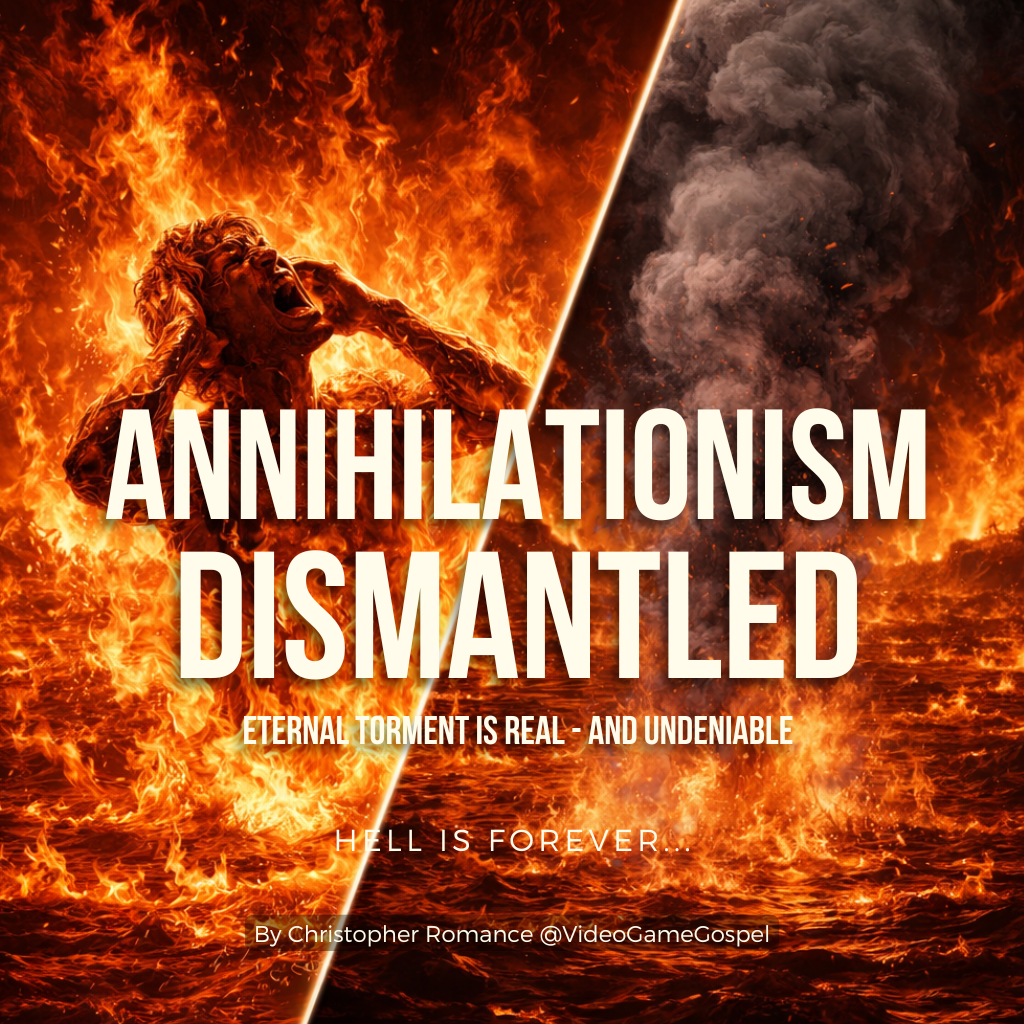
Annihilationism can be explained as a belief that upon death, the unrepentant are sent to Hell, and eventually are destroyed to the point that they cease to exist. This viewpoint got mainstream attention when on Kirk Camerons Podcast, he mentioned how he believes that Annihilationism might be true.
This sparked a lot of backlash from the popular and influential teachers online, some condemning Kirk, others shaming him, and more calling him a heretic.
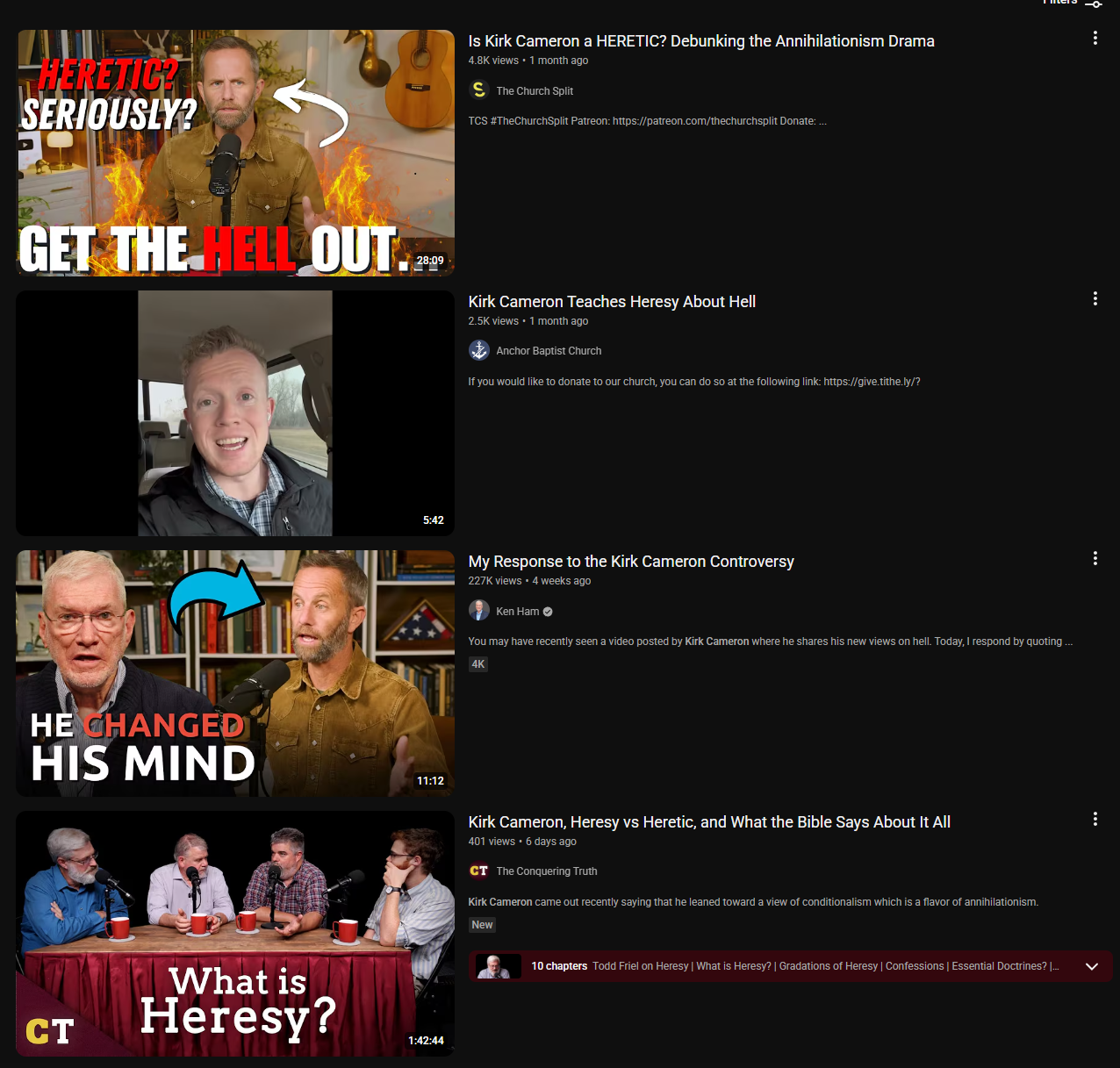
Now we should be clear from the get go, that we oppose the mainstream view of Annihilationism. However, we also want to point out how we think it is unloving, impatient, and un-Christlike to bash other seemingly faithful and true believers online. Especially with not taking the time to hear them out. Hebrews 13:1 instructs us to “Let brotherly love continue”, and 1 Peter 1:22 tells us that “Seeing ye have purified your souls in obeying the truth through the Spirit unto unfeigned love of the brethren, see that ye love one another with a pure heart fervently”
If a believer misses the mark, it is something that needs correction, but it is always something that needs to be done in a spirit of meekness, lest you also be tempted (Galatians 6:1).
Kirk himself stated in his response video that he is open to having discussion about the matter and I commend that. He is essentially saying he is not bought and sold and will not move on the position, but rather he is open to it. This is not to say that we as a ministry explicitly support Kirk Cameron. In fact, if we can be so bold, we support no one, not even ourselves, but the Word of God alone.
Now others justified their rally against him claiming that while it is all well and good to explore a topic in earnest, he should not have made such bold declarations on his podcast to so many listeners. They argue that while Kirk did not claim decisively that this doctrine is true, he certainly argued for it, and due to the size of his platform he has potentially led many to stumble. We agree with this assessment, because the Bible is clear in James 3:1 that we are not to be many masters, for we shall receive the greater condemnation. In other words, teaching comes with a high price if you teach incorrectly and lead others to stumble. 2 Peter 2 gives ample warning to false teachers, and false prophets, that should make any true Christian acquainted with the warnings of scripture to tremble before posting their thoughts online. Especially if that person has a large following and can influence many.
We understand that a podcast is discussional in nature, but to be clear, Biblical command precedes any form or function we do religiously or otherwise and we are in subjection to obedience to the word totally. Lest we walk disorderly (2 Thessalonians 3:6, 2 Thessalonians 3:14-15).
Kirk likely should have been far more cautious, and far more careful before preaching or discussing things publicly that ought to have been dealt with privately. Any public figure, speaking on doctrine (us included) must be very sure about how what they say is biblical or not. They must be very careful before openly teaching anything they have not done their due diligence on, and considered every angle, every understanding, and weighing things against the most macro and microscopic lens of scripture to come to balanced, coherent, exegetical, proper hermeneutical, logical conclusion that is perfectly aligned to the truth of God, and the Spirit which teaches us perfectly (1 John 2:27) from the very Word we read (John 17:17). The penalty for false teachers is a price not worth paying, and should give all pause, following the wisdom of scripture in 2 Timothy 2:15, before they openly teach their opinions.
In any case, though Kirk is being used as the catalyst in this discussion, he is not the focus, so we want to shift towards the real focus of this article. And that is dismantling, and debunking the belief that Conditionalism or Annihilationism exists as a viable cogent theology/doctrine.
We will explain briefly the doctrine of Annihilationism in simple terms, then using scripture and good biblical hermeneutics/exegesis show that the position is untenable with Biblical Christianity.
Our goal is to be fair, and theologically consistent throughout. We won’t strawman Annihilationism’s argument, in order to steelman our own. We will look at the strongest arguments for Annihilationism, and then let scripture do the talking.
Join us as we take a deep dive into the Bible, and explore what scripture has to say about Annihilationism.
What Does Annihilationism Argue?
As briefly mentioned before, the main tenet of Annihilationism is the belief that people who go to Hell will eventually be “destroyed” and “cease to exist”, as in “poof” they are fully gone, no more conscious eternal torment. Like wood to a fire, eventually they become ash. Additionally it teaches that we humans are mortals, and can only receive Immortality by God: Souls are not eternal by nature, and will eventually fade or die unless given immortality by God.
These are the most common proof texts for Annihilationism/Conditionalism
Malachi 4:1 - "For, behold, the day cometh, that shall burn as an oven; and all the proud, yea, and all that do wickedly, shall be stubble: and the day that cometh shall burn them up, saith the LORD of hosts, that it shall leave them neither root nor branch."
Psalm 37:20 - "But the wicked shall perish, and the enemies of the LORD shall be as the fat of lambs: they shall consume; into smoke shall they consume away."
Psalm 37:10 - "For yet a little while, and the wicked shall not be: yea, thou shalt diligently consider his place, and it shall not be."
1 Timothy 6:16 (about Jesus and us being not immortal) - "Who only hath immortality, dwelling in the light which no man can approach unto; whom no man hath seen, nor can see: to whom be honour and power everlasting. Amen."
1 Corinthians 15:53-54 - "For this corruptible must put on incorruption, and this mortal must put on immortality. So when this corruptible shall have put on incorruption, and this mortal shall have put on immortality, then shall be brought to pass the saying that is written, Death is swallowed up in victory."
Obadiah 1:16 - "For as ye have drunk upon my holy mountain, so shall all the heathen drink continually, yea, they shall drink, and they shall swallow down, and they shall be as though they had not been."
Additionally there are more verses used to support the position such as:
Death, Destroy, Perish, Devour: Romans 6:23, Matthew 10:28, John 3:16, Philippians 3:19, 2 Thessalonians 1:9, Matthew 7:13, Psalm 37:20, Hebrews 10:27, Ezekiel 18:4
Consuming Fire, Ash, Burned Up: Malachi 4:1-3, Matthew 3:12, Jude 1:7, Mark 9:43-48, Isaiah 66:24
Immortality as Gift Language: Romans 6:23, 1 Timothy 6:16, 2 Timothy 1:10, Romans 2:7, 1 Corinthians 15:53-54
"Second Death" Language: Revelation 20:14, Revelation 21:8, Revelation 20:6
Old Testament "Complete End" Imagery: Obadiah 1:16, Psalm 92:7, Psalm 37:2, Psalm 37:9, Psalm 37:20, Psalm 37:38
Examining & Debunking The Argumentation
Without getting into the various dissenting weeds or brand of Annihilationism, the main argumentation largely hinges upon strictly interpreting the words used in these scriptures with a narrow and incorrect lens. Words like death, perish, destroy, burned up, consume away, are interpreted to mean an eventual ceasing to exist despite scriptural anchor points arguing the opposite which we cover later.
Immortality
Immortality is interpreted in the modern book and film sense to mean “ever existing” and not in the Greek or Hebrew sense which means “having life” eternally. That “life” is defined by the good things of God being given to us (1 Corinthians 2:9-14), and “death” being the exact opposite of that “life”. Both states of death and life are found to be eternal in scripture, yet only one is referred to as “Immortality” (1 Corinthians 15:53-55). Additionally, death while not being a cessation of existence, is a form of existence void of all life, and for all intents and purposes the person is reduced to nothing but torment eternally. Conscious yes, but still nothing that would resemble life as defined by what we receive from God in eternity with Him. A horrible fate indeed. To exist yet not in any meaningfully positive way, to feel yet only feel pain and suffering. It makes the seriousness of Hell on a magnitude higher than what Annihilationism’s brand of Hell looks like. Which is more of a simple inconvenience to endure until you eventually cease to exist and go to nothing.
Death
When “Death” is interpreted as a cessation of existence, it runs into an issue when you consider Revelation 20:14 in context. Death and Hell are thrown into the Lake of Fire, and that act is known as the Second Death. The issue is, if Death in one sense only means going to Hell to await the Second Death, then why does the Second Death suddenly be your cessation of existence? It is logically inconsistent to say you can have Death mean one thing, and then have Second Death mean a completely different kind of thing. The word in question for Death in Greek is thanatos, which is the same Greek word used in both places in Revelation 20:14. The word deuteros used to describe the “second” death, literally means second of the same thing.
This is shown elsewhere in scripture, such as In Matthew 22:39 where Jesus is describing the Two Commandments of God on which all the Law and Prophets rest, he uses this word “second” to describe the second law. The difference in the two commands is what is commanded, not whether or not it is a command, a different type of command, or a greater or lesser command. So while yes the Second Death is different in what it entails in that Hell is one place of suffering and the Lake of Fire a different place with perhaps entirely different features, yet neither of the places are a fundamentally different thing altogether with different rules or conditions, both are death. Both are a place of eternal torment (Revelation 14:11), so to change the meaning that in one sense Thanotos means conscious torment awaiting judgement, but in the second sense it now means a ceasing to exist, is logically inconsistent. Revelation 14:11 says:
“And the smoke of their torment ascendeth up for ever and ever: and they have no rest day nor night, who worship the beast and his image, and whosoever receiveth the mark of his name.
The smoke of their torment cannot rise forever and ever if they cease to exist, nor can they have no rest day or night as a condition of their eternal internment that they do not experience that lack of rest. Experiencing a lack of rest is something that requires consciousness. How are those two things possible if they don’t exist anymore? How can smoke rise forever from something that is gone and cannot produce that smoke, or how can you have no rest day or night, if you aren't there to experience it?
I perceive one might reply that the lack of experiencing rest is only for a time, and when they cease to exist, it would from their perspective have been never resting day or night until they perished, therefore resolving that particular challenge to the view of Annihilationism. However it does not resolve the issue with their torment ascending up smoke forever and ever. You would have to argue that their consciousness ceases while their eternal body continues to smoke forever and ever. Which is a strange and unscriptural conclusion that is not supported by scripture. Especially in the presence of indicating that during this eternal smoke of torment ascending up forever and ever, they (which is a reference to conscious minds) have no rest, day or night. This verse seems to make the position of Annihilationism utterly indefensible in light of this scripture alone, let alone the others we will describe later.
Revelation 20:14 is describing literal eternal conscious torment for those who worship the beast. One might say “This is a special judgement for people who worshiped the beast not for all those in Hell” To which I would counter with Mark 9:43-48 in which Jesus is describing our attitude toward sin, and how we must completely depart from sin, lest we end up in Hell loving pleasure more than God (2 Timothy 3:1-5, Matthew 22:37-40). In His discourse on the subject, he repeats the phrasing how those with sin are cast into Hell, where the fire is never quenched, and where their worm will not die.
“And if thy hand offend thee, cut it off: it is better for thee to enter into life maimed, than having two hands to go into hell, into the fire that never shall be quenched:
Where their worm dieth not, and the fire is not quenched.
And if thy foot offend thee, cut it off: it is better for thee to enter halt into life, than having two feet to be cast into hell, into the fire that never shall be quenched:
Where their worm dieth not, and the fire is not quenched.
And if thine eye offend thee, pluck it out: it is better for thee to enter into the kingdom of God with one eye, than having two eyes to be cast into hell fire:
Where their worm dieth not, and the fire is not quenched.”
The word for “worm” here is the Greek word skōlēx, which literally means a maggot, or a worm feeding off of you. The word for “die” here is teleutaō which means “come to an end” and when it is combined with the word “ou” which means “not” literally means will not come to an end: especially when taken into context with the eternal “fire that never shall be quenched”. In context, it is speaking of the eternal never ending torment placed upon you, in the most strictest and grave sense imaginable. Here we do not see Jesus allocating conscious torment to only those who took the Mark of the Beast, but to all who enter into the next existence riddle with sin, unrepentant and unsaved.
Burned Up Consumed Away
Annihilationism translates the meaning of verses that describe being burned up, or consumed away with ceasing to exist. Similar to how wood in a fire gets burned up in our temporal universe, and ceases to be wood, and instead becomes ash. The presupposition is then, that like a piece of wood in our physical and temporal existence which has it’s nature changed from wood to ash in a fire, the same is true for the consciousness of the person in Hell in the spiritual and eternal existence. Going from conscious and alive to burned up and gone.
This logical framework relies heavily on relying on the natural world to explain the spiritual world. This is an error. Jesus told us that the natural world is not like the spiritual in John 3:12. Any serious reader of Revelation will quickly come to realize the spiritual world is very different from ours.
So to reason from the physical to the spiritual is simply unwise. We cannot rely primarily on the physical world to explain the spiritual world but rather the given context of scripture itself. This is not to say that which is spiritual is antithetical to the natural. Rather it is to say, what is natural, is not supernatural, and thus though there may be similarities you cannot reason that the spiritual follows all the same rules of the natural. The infinite nature of eternity fundamentally implies the laws of thermodynamics in the physical realm do not apply in the spiritual. There is no heat death to eternity, there is no universal constant expansion and contraction implosion event repeating ad infinitum. There is constant existence on a realm of operation we do not understand or know, and thus because we lack any measurable knowledge of the spiritual, we cannot imply from the natural to the spiritual with complete certainty.
Certain things comport that seem to be in the very least hyper natural if not supernatural such as thought and conscience existence, in which science can’t explain why a thought happens, or when it comes from, only that it does and the mind facilitates the thought, so things like suffering in the natural is a negative experience, can logically comport to the same thing in the supernatural or spiritual realm. In short, what can be comported by context or sound reasoning from the physical to the spiritual using stated biblical context are allowable in your interpretations, but things that are unproven, such as the operation of particles in the spiritual (if it is even made up of particles) cannot be reasonably assumed.
In layman's terms: You cannot use the physical world to explain the spiritual one, because they are two completely different things altogether, that share commonalities, but are not in fact the same thing. Physical wood burns, turns to ash, and then turns into a myriad of other particles in our universe, never being truly destroyed. The properties of a body in Hell (which is a spiritual place) and the mind/soul/consciousness that inhabits that body are completely undefined and unknowable outside the revelation of scripture, which again tells us that they will experience no rest day or not as the smoke of their “torment” ascends forever and ever. Additionally when examining these claims we have to take in the whole host of scripture, which oftentimes makes anchor statements that set the standard.
For example, if the scripture somewhere makes it abundantly clear on a particular issue that it cannot be taken another way, such as Ephesians 2:8-9 that “For by grace are ye saved through faith; and that not of yourselves: it is the gift of God: Not of works, lest any man should boast.” You cannot argue elsewhere such as from James 2:14-26 that works earn your salvation. You have to take the clear standard of scripture that salvation is a gift from God, to understand that James is speaking about how saving faith produces works, and not that works produces salvation. He is speaking about the result of a heart that is truly converted, and the hypocrisy of ones who have no works to show for their so-called faith, in that it is then dead.
So therefore, we must find all scriptures as it pertains to Hell, death, and Eternal life and look for inarguable anchor points, and form our theology around them. Anchor points like Matthew 25:46 which read:
“And these shall go away into everlasting punishment: but the righteous into life eternal.”
Not only this, but the very context of passages, or the grammatical Hebraic/Greek rules disallow such false interpretations propagated by Annihilationism. Many of which we will explore later in detail.
Summary Of Annihilationism’s Error
To the Conditionalist/Annihilationist “death” means cessation of existence, yet this definition cannot be substantiated by scripture, without ignoring many scriptures that make it clear ceasing to exist cannot happen, but rather a transformation of value and existence to that of suffering and eternal anguish.
In essence, destruction, damnation, death, are not words of cessation of existence. “Death” in the biblical sense, does not mean cessation of existence, but it means a cessation from life eternal.
Similarly, “Life” is a cessation of sin and death, NOT just a granting of eternal conscious existence. Terms like immorality are tainted by our common understanding based on books, movies, and shows that paint immortality as not being able to die.
To understand immortality properly would be to understand the difference between earthly death, and spiritual death, and earthly life and spiritual life. All of us reading this right now, have earthly life, and most of us will experience earthly death, yet hopefully everyone reading this will only experience spiritual life upon “death”. And not spiritual death upon death.
Again, death, life, and immortality are improperly understood by the Annihilationist. Death is improperly seen as an eventual ceasing to exist, rather than an existence deprived of life eternal. And life is reduced to just a continual existence, instead of ceasing from all sin and death, by being brought into the glorious light of Christ, obtaining those things eye hath not seen, nor ear heard, nor has entered into the heart of man what God has prepared for those who love Him (1 Corinthians 2:9).
The offense of Annihilationism is it severely undermines the absolute severity of sin, and the indescribable love of God demonstrated through Christ Jesus and His work. Additionally, it shifts the motivation to get people into heaven from “You will burn in Hell forever” to “You will miss out on eternal life, but it’s not that bad, just suffering for a while then you will be gone”.
Why Many Hold This View
Now, I imagine the position is popular because it sounds/feels nicer to people than the reality that those who die in their sins are tormented in Hell forever.
It sounds a lot better to unbelievers who have a hard time believing God is “all loving” when He sends people to Hell for an eternity of torment for their sin. Again, this is an issue of not understanding the severity of sin and the nature of God Himself, something we will discuss in more detail a bit later.
Now while this position (that unbelievers eventually cease to exist) is more aesthetically pleasing to many, it does not make it true. Furthermore one who finds it more appeasing reveals their heart as one that does not understand the sheer depravity of their sin. When a person understands how incomprehensibly evil their sin is to a Holy Righteous and Perfect God, and they catch a real glimpse of just “how bad” their sin really is. They will begin to agree with the position God has for sinful man, that they must be tormented in Hell forever. In fact this is a prerequisite to true repentance and belief. The knowledge of the utter depravity of your sin, which turns your sinful heart to God in humble submission, begging for His mercy, which He provided on that cross through Jesus Christ our Lord.
This punishment of eternal Hell fire is actually the opposite of unfair, and is in fact perfectly fair and just. And while some see it as extreme for God to send people to Hell forever in torment, who undoubtedly hold some measure of love for their sin, it is revealed to the mind of the person who sees their sins as exceedingly sinful (Romans 7:13) that not only is the punishment fair and just, it is no where near extreme or unfair as proposed. I then contend that the one seeking Annihilationism must stop in their tracks, quake in fear (2 Corinthians 13:5, Philippians 2:12), and recognize that perhaps their hearts do not entirely belong to God (Matthew 15:8-9, Isaiah 29:13). In such a way that they think their sin is not severe enough for eternal punishment. Pause to consider yourself before God, if this is you.
Sinful man scoffs at God’s law, sees their iniquity like it were water and drinks it down plentifully: Job 15:16
“How much more abominable and filthy is man, which drinketh iniquity like water?”
What is appeasing or “fair” to a sinful man's mind, is almost undoubtedly abhorrent to God. Especially when those things are creations of man’s mind and not of Scripture, which is filled with culturally uncomfortable commands, ones which make you choose between obedience to God, or loving the world. And to the worldly man, perhaps even someone who claims they follow Christ, these commands can be hard to accept. The measure in which we love the world, will be the measure in which we will lean towards positions that go against the word of God. Ye cannot love God, and mammon (Matthew 6:24 “No man can serve two masters: for either he will hate the one, and love the other; or else he will hold to the one, and despise the other. Ye cannot serve God and mammon.”
1 John 2:15-17
“Love not the world, neither the things that are in the world. If any man love the world, the love of the Father is not in him. For all that is in the world, the lust of the flesh, and the lust of the eyes, and the pride of life, is not of the Father, but is of the world. And the world passeth away, and the lust thereof: but he that doeth the will of God abideth for ever.”
The Word of God will endure forever, and you and I are but vapors who endure for a time and vanish away in the temporal sense. Our lives are vain, and so is our internal comforts, positions, and dispositions. Thus the folly in making our doctrine more amenable to our internal comforts, other believers who cannot stomach the meat, or especially the world. It is folly, and always will be, the result of which produces wrongful doctrine/belief.
Now it may be said that the motivation to explore such a position (Annihilationism), does not necessarily need to derive from a position of making it more amenable to sinful man. It can be said that it is just as likely the motivation is purely explorative, seeking after truth in the fullest sense and my diatribe is unwarranted.
Granted, I can indeed see someone innocently exploring this topic, seeking truth. However I do think it is important to examine ourselves to see if we are in the faith (2 Corinthians 13:5) - Which is perhaps what people are doing; But even so, motivations do matter, one must examine why they are in particular seeking out this doctrine, and exploring its validity.
Is it because your natural state responds better to the idea of the wicked ceasing to exist? That perhaps someone you love, for example a dear grandmother, or grandfather, your friend, or loved one, will eventually perish and their suffering will end, who you know went to Hell? That does seem to be nicer doesn’t it? That those who we have loved, that we know died and likely went to Hell, will be free from suffering one day.
I imagine for most, the reason for exploring this doctrine, is not out of pure curiosity and seeking truth wherever it leads, but rather a perhaps somewhat hidden desire, that our loved ones who have died and went to Hell won’t be there forever.
The conflict arises out of our love for them, we feel it cruel to let them suffer for eternity. So we tend to gravitate towards a more amenable position, where they eventually will stop suffering and just cease to exist. Yet is it biblically true? And does the belief grossly misunderstand the severity of sin, and the sheer majesty of God’s love demonstrated through Christ?
The answer is yes. Annihilationism completely fails and is an affront to both the severity of sin, it’s true consequences, and the magnitude of incomprehensible love God showed for us. It undermines God’s work entirely, and makes sin far lighter than it could ever be. It brings sin down to the human level.
The idea of the eternality of Hell is uncomfortable to many Christians, yes, and as previously mentioned, it is often the Atheist that rejects God on the premise of “How can God say He is all loving, when he sentences people to an Eternity of suffering in Hell”. It is then, the Christian is faced with the uncomfortable truth to that scoffer that “it doesn’t sound all that loving does it?”.
The Two Major Failures Of Conditionalism/Annihilationism
NOT Seeing Sin As Exceedingly Sinful
As mentioned previously, the Bible tells us that we are so wicked, we drink iniquity like it was water (Job 15:16) which in other words means to us, sin is as “innocent” as drinking a glass of water. We do it by nature, willingly (before salvation and being born again), and happily.
As a fish does not know it is wet, so does man not know the sheer depravity of their sin which they drink as though it were a simple glass of water. Mortal man who has not been redeemed, born again, and made new in Christ Jesus cannot grasp sin's depravity, unless it is revealed to them by the Law of God.
The law which tells us lying lips are an abomination to God (Proverbs 12:22). God will hold no one guiltless who takes His name in vain (Exodus 20:7), and that all liars will have their part in the lake of fire (Revelation 21:8), and how our hatred is murder (1 John 3:15), our lust is adultery (Matthew 5:28), and thoughts are wicked all the day long (Genesis 6:5).
You and I are evil, wicked and wretched. That can only be washed clean by the blood of Christ, shed on that cross as total payment for our sins.
Now as a truly born again Christian grows in sanctification and moves further along the path of Christlikeness, removing and purging oneself of sins (2 Timothy 2:21), those former sins like lying become more and more abhorrent.
What was once second nature to you such as telling a lie to avoid consequences, or lying to get a job, lying to avoid offending others, becomes abhorrent to you as you grow in Christ.
Consider that even the most Christlike man is himself leagues away from perfection, and can never reach unto perfection until we are raised to Life with the coming of Christ, or we pass from this life into Paradise with Christ (Luke 23:43). Until then, we are in a constant battle against the flesh. Yet even so, are not those former things, our lives of sin, now abhorrent to us?
If so, I want you to stretch your imagination to the greatest, most obedient, most sinless version of yourself, and realize that even then you fall short of the glory of God (Romans 3:23). How much more would you abhor sin in that state compared to now?
Now from that position, imagine how God is already maximally perfect beyond anything you could achieve in sanctification and obedience to Him. If sin to us in our greatest state would be inexpressibly abhorrent, how much more is sin in its true form to God? Not only this, but whose opinion on the severity of sin matters? Yours? Mine? Or the Creator of all life, and the Judge of the universe?
When you stand before God on judgement day, it is not your standard that will be used, not mine, not your churches, not your neighbours, but His; Sin to an infinite, eternal, incomprehensibly perfect God is likewise infinitely evil, eternally committed, and incomprehensibly wicked. There is no more just, and fair punishment for our sin, than an eternity in Hell. It is not extreme, a stretch, or unfair, if anything it is perfectly fair and just, yet even so God has provided a way for you to not go there. That is incomprehensibly loving and merciful. To have full knowledge of your sins inside and out (Proverbs 15:3), and yet provide you a way out, despite not needing you in any sense. That brothers and sisters, is love unfeigned.
Not Understanding the Matchless Love Of God
Despite you and I being irreconcilably wicked, putrid, disgusting wretches not worthy of anything but an eternity in Hell. God, who is rich in mercy, who needs not our love, our attention, or our existence, humbled himself to the cross, and gave his mortal life up on that cross, to make payment for the sins you and I have committed.
Only an immortal, sinless, perfect God, could cover with the blood of His Son, your incomprehensibly wicked sins.
The love of God is shown, that though we were sinners, Christ died for us:
”But God commendeth his love toward us, in that, while we were yet sinners, Christ died for us. Much more then, being now justified by his blood, we shall be saved from wrath through him. For if, when we were enemies, we were reconciled to God by the death of his Son, much more, being reconciled, we shall be saved by his life. And not only so, but we also joy in God through our Lord Jesus Christ, by whom we have now received the atonement. Wherefore, as by one man sin entered into the world, and death by sin; and so death passed upon all men, for that all have sinned: (for until the law sin was in the world: but sin is not imputed when there is no law. Nevertheless death reigned from Adam to Moses, even over them that had not sinned after the similitude of Adam's transgression, who is the figure of him that was to come. But not as the offence, so also is the free gift. For if through the offence of one many be dead, much more the grace of God, and the gift by grace, which is by one man, Jesus Christ, hath abounded unto many.”
Romans 5:8-15
You see, God did not need to die for us, He could just as easily erase everything and start over. Yet our GREAT GOD YHWH, gave his life for us. The Just for the unjust (1 Peter 3:18). Because HE is good, HE is love, HE is the Lord of Lord and the King of Kings.
Why Annihilationism Disgraces Both
Sin is an eternal offence before an eternal God, that requires the payment of the Son of God’s life on that cross to be shed, to wash away our sins. Annihilationism reduces sin to mere temporal punishment like that of man’s penal punishments: in which you do your time and you are eventually set free. The Conditionalist’s plea to the lost sinner is “your suffering in Hell will end eventually, because your sin was only temporal.” instead of the Bible which declares your suffering in Hell is eternal, now repent and believe! (Luke 13:3)
You and I have sinned before a Holy God, in whom you will answer to on the day of judgement. Though your sin is incomprehensibly wicked and evil, and there is no other just judgement than an eternity of suffering in Hell. God who is rich in mercy sent His Son down to Earth to die on the cross so that you may be spared of this fate, and have eternal life. Herein is the majestic love of God shown to you.
Jesus, who is God shed His precious blood as payment for what would have been an eternity of your torment. Christ became sin, who knew no sin, that we might be made the righteousness of God (2 Corinthians 5:21). No greater act of love has been done in all of history. Nothing can compare to the love of God and his sacrifice on that cross.
Annihilationism teaches that God's judgment is effectively temporal while somehow remaining an eternal verdict. In this view, after you cease to exist, God still holds judgement against you for the you that doesn’t exist. Such a position is logically incoherent. It essentially teaches that the verdict stands forever but the punishment itself is only temporal. But this creates a contradiction: How can a punishment be called 'eternal punishment’ as it does in Matthew 25:46 and Daniel 12:2 if the one being punished no longer exists to experience it? Annihilationism will say that it is because God has passed the decree to be eternal, that it is still an unending punishment you cannot escape from. But again, this creates a logical contradiction: Punishment is only punishment, when there is something being consciously punished. You could not torture a human who is not conscious and experiencing the torment.
A person who has been anesthetized experiences no pain or ‘torment’ when they are receiving life saving surgery, simply because they are not conscious to register the pain being sent to their brain from their body. Similarly if punishment is eternal, it can only be so, if the person is able to experience it. If they cease to exist, they cannot be punished. To torture a person who is completely unconscious would be considered mutilation but not torment. Worse yet is if the person and body ceases to exist eventually, this eternal punishment is then impossibly punishing nothing. Which makes zero logical sense. This is where Annihilationism fails to stand the test of scripture.
When looking at verses like Matthew 25:46 and Daniel 12:2 which declare the eternality of 'everlasting punishment' and eternal life in the same sentence which are perfectly and purposely juxtaposed against one another to show the consistency of each in it’s form and function. It becomes clear both are intended to be understood in the same way. One is everlasting punishment, and one is eternal life. Both never end.
Matthew 25:46 uses the same word (aiōnios) in the words 'life eternal' as it does in ‘everlasting punishment’ in the exact same sentence. If eternal life means ongoing, conscious joy with God forever, then eternal punishment must mean ongoing, conscious suffering forever in Hell. You cannot divorce the word from its ongoing experiential reality in one case but not the other., especially when both words are used in each place and juxtaposed in the same sentence against one another.
Consider an additional problem Annihilationism creates:
If sin is merely temporal, and the punishment towards you consciously temporal, then how much less would be the payment of Christ to save you from such penalty? Thereby effectively undermining the severity of sin and the matchless love of God.
Additionally, If one contends sin is eternal but the punishment temporal in effect, it would leave the burden of proof on the person making such a claim to demonstrate that distinction through scripture.
How can sin be eternal, but the punishment temporal? Do you then question that Christ’s work was also eternal, but only temporally lasting? Will we go to Heaven and cease to exist there?
You must apply the logic to both in order to be grammatically and intellectually consistent. One part of a scripture such as Matthew 25:46 and Daniel 12:2, cannot be divorced and reinterpreted individually in the same sentence to carry two completely separate meanings. If the word everlasting/eternal (aiōnios) means one thing, then regardless of the word it is applied to (death or life) it must then mean the exact same thing. If eternal life means eternal life, then eternal damnation means eternal damnation. There is no contextual or scriptural delineation from that understanding that is logically possible in the grammar.
I would ask the Annihilationist: Why does Christ’s life, death, and resurrection offer you eternal life, but when it comes to death that same eternality (aiōnios) somehow does not apply?
While attempting to seem fair, Annihilationism diminishes the utter depravity of sin, and the sheer majesty of the sacrifice of Christ. One should pause if their theology undermines both sin, and more importantly the work of Christ. It is guaranteed that if your theology undermines Christ and His work on that cross, it is likely not coming from the word of God, but perhaps another source. At best, the depravity of sinful men who do not understand the severity of sin, and at worst, doctrines of devils (1 Timothy 4:1).
In summary, Annihilationism and its implications, undermines the seriousness of sin, the eternal power and authority of God, the majesty of the work of Christ on that cross and His subsequent resurrection, and why it is so vitally important to preach the Gospel.
If the end result of every human being is eternity of suffering in Hell for their grievous crimes, then the motivation to preach unto them the saving power of God through the Gospel of Jesus Christ our Lord becomes undeniably more important than anything else. If the motivation is to save them from eventually ceasing to exist, then our motivation is severely undermined. Why share the words of life? Why not adopt a more passive view of doctrine, sin, and the need to preach the Gospel? Annihilationism leads one to conclude “All they are truly missing is good times in life eternal, sure they will burn in torment, but only for a while. Yes it is sad, but oh well! They made their choice, I do not need to follow Luke 14:23 and compel men to come to Christ.”
The word used in Luke 14:23 is anagkazō which means to necessitate, compel, drive to, constrain by threats, by permission, entreaties, by other means. Which entirely means that you do everything at all possible to compel them short of actually forcing them to believe (which you can’t actually do).
Not only is the threat of Hell diminished, Salvation itself is diminished to just getting the best possible outcome, and simply existing forever. Annihilationism completely undermines sin, salvation, heaven and hell, in an attempt to be more tolerable to sinful man. This is why we must not allow such thinking to continue as the outcome of the belief is more than merely a difference of opinion, but truly something that shipwrecks one's faith. Underlining the importance of holding biblically true doctrines, and nothing else. For even the smallest error can lead to the most catastrophic outcomes.
Additional Verses To Consider
By now, the Biblical position on the eternal suffering of Hell and the eternal joys of Heaven should be thoroughly established. We understand now that the failure of Annihilationism, as with any other improper doctrine, is a failure of interpretation, and Eisegesis.
One could argue the minutia of the text back and forth forever in order to try and prove their point, but each such bout of back and forth vibrato would require applying your own meaning to the text, and ignoring the verses that leave zero room for that interpretation. I submit to you the reader that any and all false doctrine and theology can be easily dismantled by looking at the context and whole host of scripture: finding those anchor points that leave no room for interpretation. Keep in mind the words of the Apostle Peter who said “Knowing this first, that no prophecy of the scripture is of any private interpretation.” - 2 Peter 1:20
Which means that we do not get to produce our own understandings of the text and apply them liberally across scripture. We must instead let the plain reading of scripture interpret scripture. If the text says eternal death, and eternal life in the same sentence (Matthew 25:46, Daniel 12:2, John 5:29) then we do not get to redefine those terms at will to mean two different things. We look to the Greek, read the context, and see what the rest of scripture says.
Additional Verses & Concepts To Address
One thing not done yet in this teaching, is to address the “problem” verses that Annihilationists will undoubtedly bring up.
Instead of addressing each verse individually, going to the Greek or Hebrew, debating semantics, we will clump the verses often used into two categories and explain the overarching error that occurs within these two categories.
Verses that speak of physical death.
Verses that speak of spiritual death.
Physical Death & Spiritual Death
Physical death to both the Annihilationist and the Biblical Christian can be simply explained as an absence of physical life. The heart ceases to beat, the body decays, and the spirit inside the person which formerly interacted with this physical world is for all intents and purposes no longer present on the Earth and/or in that body. But as any Christian knows, whether they be Annihilationist or follow Biblical Christianity: physical death is not the end of our experience, and our souls carry on to the next destination be it Heaven, or Hell for the unbeliever/unrepentant sinner.
Spiritual death is where biblical Christianity and Annihilationism disagree. Annihilationist’s shift the definition of death in the spiritual to a cessation of existence. Where Biblical Christianity carries over that spiritual death is also like the physical counterpart in that it is experiencing an absence of spiritual life, and not a cessation of existence:
In simple terms, if you take death as represented by the direction of south on a compass, and life as the direction of north on a compass, and simply move location, one from the physical realm on Earth, and on to the Heavenly realm, the fact that south is the opposite of north does not change. All that has changed is location, and thus consequence of being in that location.
Death (or rapture) on Earth transitions you to your final predicament, it is the vehicle that transports you to your everlasting reality and really is the result of your own sin (Romans 6:23). When you die you face two realities:
Continue in your just reward and suffer conscious eternal torment and destruction in Hell
Have the blood of Christ to cover your sins and be granted eternal life.
You see, life is not defined as simply continuing forever. That understanding is by far the most anti biblical and bleak position one could take about life. No, you see life is defined by being perfectly content, made like the angels, where there will be no more sorrow, no more suffering, and no more sin and death. It is a place like the Garden of Eden yet precluded from the possibility of sin, for sin and death can no longer exist in that place. It is a perfection of existence that is where we have our hope, that ultimately is only made perfect by God Himself. In essence, God is immortal Life (1 Timothy 6:16), and it is God whom we receive in the spiritual, not just existence forever. Annihilationism reduces spiritual life to something bleak, sad, and anti-biblical. They do the same where death is the exact absence of all I just described about life, it is only sin and death eternally, where no “Eternal Life” dwells: which is defined as a place of pure torment and suffering ad infinitum. Nothing good, nothing full, nothing well, nothing comforting, nothing that is life. And when you understand this, you understand why God calls it “everlasting destruction” in 2 Thessalonians 1:9.
This is primarily what Annihilationism gets wrong. They assume without any proof, that death means cessation of existence while simultaneously admitting the fact that physical death does not cause us to cease.
When you understand that all of the verses cited in the beginning of this teaching as “proof” texts for Annihilationism fall into those two categories, it becomes pretty easy to clear up the confusion.
Some verses deal with the death of a nation, or a people, or the wicked in categorical fashion, some deal with the individual and use words like destruction, or being destroyed. But all of it can be understood through the biblical lens of what death actually is, and life actually is, and Annihilationism gets these both, woefully wrong.
Apollumi and Olethros
Annihilationists tend to anchor their position on the incorrect usage of these two Greek words: Apollumi and Olethros and the strongest verses using these Greek words are: Matthew 10:28, 2 Thessalonians 1:9, and Obadiah 1:16 .
“And fear not them which kill the body, but are not able to kill the soul: but rather fear him which is able to destroy both soul and body in hell.”
- Matthew 10:28
“Who shall be punished with everlasting destruction from the presence of the Lord, and from the glory of his power;”
- 2 Thessalonians 1:9
“For as ye have drunk upon my holy mountain, so shall all the heathen drink continually, yea, they shall drink, and they shall swallow down, and they shall be as though they had not been.”
- Obadiah 1:16
Some notable scholars contend that these words DO mean a cessation of existence, and the primary concept there is that the words do in fact mean a total destruction. To which we agree, you are totally destroyed in Hell. However where we largely disagree is what that actually means.
No scholar can textually or lexically argue that total destruction means cessation of existence. Not to make the same error as the annihilationist and reason from the physical to the spiritual, but even in the physical no matter is ever created or truly destroyed. To suggest that the spiritual world consists of these properties of total destruction would necessitate you can prove it via scripture. Which fundamentally cannot be done. There is no total cessation of existence verse anywhere to be found in scripture.
What there is language that people are interpreting to mean a cessation of existence, without substantial proof to the claim.
Another totally viable, cogent and arguably more defensible interpretation of those same words, is total ruin. Which if you compare to a city which is destroyed, and is left to total ruin, we understand that it means that whatever good use that city had, is utterly destroyed, not that the city has ceased to exist. That’s why we have ruins we can visit today. It is dead, gone, destroyed, yet remains… This is your existence in Hell.
You are a former shell of what you were, left to utter depravity and torment for eternity. Which is an existence so terrifying, I shudder to imagine it.
That, and that alone is what can be proved by scripture, where there is an absence of proof for total cessation of existence in scripture. We will now prove this to you as we go through some final verses on the matter.
Scripture Anchors From the Old To The New
There is a fascinating connection between the Old Testament and the New on this subject, and that is found by reading Daniel 12:2 and John 5:29.
Daniel 12:2
“And many of them that sleep in the dust of the earth shall awake, some to everlasting life, and some to shame and everlasting contempt.”
Albert Barnes in his Notes on the Bible commenting on Daniel 12 said:
"The word rendered 'everlasting' is the same in both [clauses], and if it denotes eternal duration in the one case, it must in the other. No one can show any reason why the same word should not be understood in the same sense in both parts of the verse." Source: Barnes, Albert. (1847). Notes, Critical, Illustrative, and Practical, on the Book of Daniel. New York: Leavitt & Allen. (Commentary on Daniel 12:2)
The great bible commentator Matthew Henry wrote:
"Some shall awake to everlasting life. As the happiness of the righteous will be everlasting, so will the shame and misery of the wicked. They shall rise to everlasting disgrace—they shall be had in everlasting contempt, both by God and man." Source: Henry, Matthew. (1706-1721). An Exposition of the Old and New Testament, Vol. 4. London: Joseph Ogle Robinson. (On Daniel 12:2)
E.B. Pusey in Daniel the Prophet wrote a very similar conclusion:
"The construction is precisely parallel. 'Everlasting life'—'everlasting contempt.' The same word 'everlasting' (עוֹלָם) is used of both. One word determines the duration of both states. If the life be everlasting, the contempt must be everlasting also." Source: Pusey, E.B. (1864). Daniel the Prophet: Nine Lectures. Oxford: John Henry and James Parker. (Lecture IX, on Daniel 12:2)
John 5:29
“And shall come forth; they that have done good, unto the resurrection of life; and they that have done evil, unto the resurrection of damnation.”
Albert Barnes, Notes on the New Testament reads:
"Unto the resurrection of damnation - literally, the resurrection of judgment; that is, they shall be raised up to be judged or condemned. This does not mean that they would be condemned, tried, and destroyed, but that they would be condemned to everlasting punishment." Source: Barnes, Albert. (1832). Notes, Explanatory and Practical, on the Gospels: John. New York: Harper & Brothers. (On John 5:29)
Matthew Henry, Commentary on the Whole Bible reads:
"They that have done evil shall come forth to the resurrection of damnation. There will be a resurrection of the unjust (Acts xxiv. 15), who shall rise to shame and everlasting contempt, Dan. xii. 2. It shall be a resurrection to judgment, and that judgment a condemnation to an everlasting state of misery and torment." Source: Henry, Matthew. (1706-1721). An Exposition of the Old and New Testament, Vol. 5. London: Joseph Ogle Robinson. (On John 5:29)
John Gill, Exposition of the Bible:
"Unto the resurrection of damnation; such whose works have been evil, will rise to everlasting shame and contempt, to be adjudged to everlasting punishment, and to be cast, both body and soul, into hell; which will be the second death, and an everlasting one, even a dying forever." Source: Gill, John. (1746-1763). An Exposition of the Old and New Testament, Vol. 7. (On John 5:29)
J.C. Ryle, Expository Thoughts on John:
"Let us note that there will be a resurrection both of the just and of the unjust. All shall rise again with their bodies, to be judged according to their works. The believing servant of Christ shall rise to eternal life and glory. The unbelieving despiser of the gospel shall rise to shame and everlasting contempt." Source: Ryle, J.C. (1869). Expository Thoughts on the Gospels: John, Vol. 1. London: William Hunt and Company. (On John 5:28-29)
These two verses read side by side say the exact same thing in the exact same way yet written over 600 years apart! That is no mere coincidence but God establishing the Truth on the matter. What is fascinating is even the grammatical construction in the Greek and in the Hebrew are made in the exact same structure. Both use the exact same word to describe the everlasting nature of “life” and the everlasting nature of “contempt/damnation”. In Hebrew the word is עוֹלָם ʿôlām and in Greek the word is ἀνάστασις anastasis.
2 Thessalonians 1:8-10
“In flaming fire taking vengeance on them that know not God, and that obey not the gospel of our Lord Jesus Christ: Who shall be punished with everlasting destruction from the presence of the Lord, and from the glory of his power; When he shall come to be glorified in his saints, and to be admired in all them that believe (because our testimony among you was believed) in that day.”
Again, like the other two verses above, this verse anchors everlasting destruction, which cannot last forever “everlasting” if the destruction results in a cessation of existence. In order for destruction to continue, the person being destroyed must forever continue as well. Otherwise what you have is just destruction, not “everlasting destruction”.
The word used for everlasting is aiōnios (αἰώνιος) which means in the literal sense “without beginning and end, that which always has been and always will be” it is the same word Jesus uses in Matthew 19:29 about everlasting life, and in Matthew 25:46 where Jesus describes the eternal state of the believer receiving life eternal “aiōnios (αἰώνιος)” and the wicked receiving everlasting “aiōnios (αἰώνιος)” punishment.
It gets increasingly hard to separate the conclusion of the goats sent to everlasting “aiōnios (αἰώνιος)” punishment, and the sheep to life eternal “aiōnios (αἰώνιος)” when the same word used for the eternal punishment of the wicked is the same word used for life eternal.
Grammarians call the construction of the Greek passage in Matthew 25:46 (καὶ ἀπελεύσονται οὗτοι εἰς κόλασιν αἰώνιον, οἱ δὲ δίκαιοι εἰς ζωὴν αἰώνιον) as it pertains to the "life eternal" and "everlasting punishment" phrases as an anarthrous noun-adjective constructions.
Which is gobbledygook speak for each word for κόλασιν (punishment) and ζωὴν (life) being bound together by the modifier αἰώνιον (everlasting/eternal).
Not only this, but Jesus purposefully paralleled these two things in deliberate contrast for us all to see and understand the eternal state of both.The same was done in Daniel 12:2 and there is no room in the text for each destination to be temporal while the other eternal, as the same word, by the same person (Jesus who is God) is spoken about the same thing, life or death, heaven or hell, punishment or life.
Christ has already given the final word on the matter. Whether an individual's everlasting state is that of everlasting life, or that of everlasting punishment, the unending, “eternal” nature of both outcomes is the same.. Or in other words, people who end up in Hell are perpetually there for eternity. And people who end up in Heaven through Christ Jesus, are also perpetually there for eternity.There is no mention of you ever ceasing to exist in either place, and the very word formation from the mouth of Christ, precludes the alternative possibility in either case. Otherwise, if you apply a temporal meaning to the first half “everlasting punishment” you necessarily need to apply the same meaning to the second half “life eternal”. To not do so, is to ignore the very words of Christ, crafted in perfection in the Holy Word of God, to which every jot and tittle (Matthew 5:18) shall endure, even after the passing of Heaven and Earth.
In short, Christ our King has declared inarguably the eternality of both those in destruction/hell/punishment/etc and those in life/heaven.
Final Admonition
Annihilationism fails the test of scripture by ignoring powerful verses that cannot be dismissed. It comports its own meaning onto the text, and makes illogical conclusions that cannot be supported by the plain reading of scripture.
It undermines the grace of God, the severity of sin, and the matchless love of God. It logically calls into question the eternality of our existence with God as born again believers by applying a temporal existence to one part of scripture but not the next.
And ultimately is not something that can be undeniably proven by scripture.
The motivations to believe such a thing may be curiosity, but it is more likely the motivations are purely out of a wrongful heart position, which refuses to admit the severity of sin. This is something that causes me great concern as a fellow believer in Christ.
Seeing your sin in it’s full light (as much as it is humanly possible to do so) is the foundation of true genuine repentance and belief. Psalm 51:17 boldly says “The sacrifices of God are a broken spirit: a broken and a contrite heart, O God, thou wilt not despise.”
It is through The Law of God, that gives us the knowledge of our sin, that we see our sin as exceedingly sinful (Romans 7:13) and truly repent and believe.
This is what makes a person truly born again, an abandonment of the love of this world, for a love for God (1 John 2:15) that is shown out by your actions and life (James 2:17-20).
Why is Hell eternal? Perhaps because sin is that serious, and the only reason we struggle to see that is because we are so incredibly sinful that we think it unfair. Perhaps if we saw sin, the same way God does, we would see how our judgement is fair and appropriate for the crimes we have committed.
The one who has stolen, tends not to judge the thief as harshly as the one who never has. Thus, God being free from sin, and all of its effects (Hebrews 3:13) sees sin as it truly is, and thus the judgement is as equally met to the measure of the crime we committed. We think lying is no big deal, yet when wall street bankers lie and cheat us out of our hard earned money, or the large companies, or the government etc, we get upset. Even when the evil (us) see others do evil and it directly affects us, we understand how abhorrent lying is. But our own sin? No… that is excusable it would seem
Romans 14:12 tells us
“So then every one of us shall give account of himself to God.”
Will you stand on judgement day? Do you have the blood of Christ to wash away your grievous sins? Have you truly turned from sin? Have you repented and believed on the Son for everlasting life?
This gift of God, eternal life as we discussed in this teaching, is given to you freely:
Ephesians 2:8-10
“For by grace are ye saved through faith; and that not of yourselves: it is the gift of God: Not of works, lest any man should boast. For we are his workmanship, created in Christ Jesus unto good works, which God hath before ordained that we should walk in them.”
It has been made free by the payment of Christ Jesus on that cross for your sins so that you may doo good works, that God ordained we should walk in them, and be holy as he is holy:1 Peter 1:15-17
“But as he which hath called you is holy, so be ye holy in all manner of conversation; Because it is written, Be ye holy; for I am holy. And if ye call on the Father, who without respect of persons judgeth according to every man's work, pass the time of your sojourning here in fear:”
Hell is terrifying, eternal, and not a place where I wish anyone to go. Yet the choice is ours. Will you return, repent, and bow before the Holy God, accept His Son as the payment for your sins, turn and believe? Or will you perish?
Luke 13:3“I tell you, Nay: but, except ye repent, ye shall all likewise perish.”Ezekiel 18:23
“Have I any pleasure at all that the wicked should die? saith the Lord God: and not that he should return from his ways, and live?”Ezekiel 33:11
“Say unto them, As I live, saith the Lord God, I have no pleasure in the death of the wicked; but that the wicked turn from his way and live: turn ye, turn ye from your evil ways; for why will ye die, O house of Israel?”
2 Peter 3:9
“The Lord is not slack concerning his promise, as some men count slackness; but is longsuffering to us-ward, not willing that any should perish, but that all should come to repentance.”1 John 1:9
“If we confess our sins, he is faithful and just to forgive us our sins, and to cleanse us from all unrighteousness.”
John 3:16
“For God so loved the world, that he gave his only begotten Son, that whosoever believeth in him should not perish, but have everlasting life.”
Repent and believe while it is still called today. Live for Christ, turn from wickedness, “And fear not them which kill the body, but are not able to kill the soul: but rather fear him which is able to destroy both soul and body in hell.” Matthew 10:28
Hell is real, forever, eternal. But so is everlasting life, gifted to each person who freely chooses to accept, or deny and face the consequence You must choose, choose rightly because your choice is eternally consequential.
THANK YOU FOR YOUR SUPPORT
 SUPPORT THIS ARTICLE