PAGAN HOLIDAYS & SEPERATION FROM THE WORLD: Easter, Christmas, Halloween (MINI-TEACHING)

Table of Contents
Table of Contents
BEFORE YOU READ:
We made a FULL version for the main argumentation if you have the time:
If you want the full argumentation, please click/tap above
Introduction
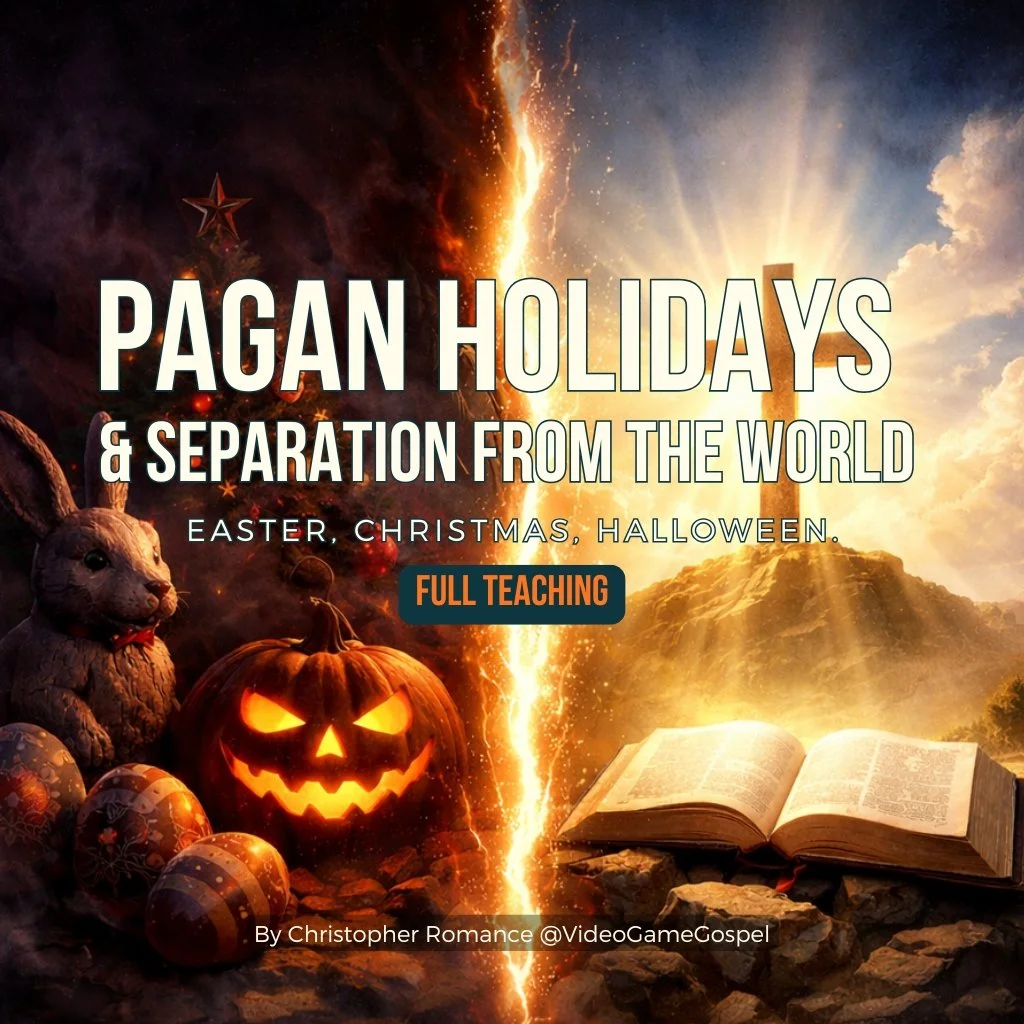
Christians celebrating Easter, Christmas, and Halloween is a normative feature of today's Christian landscape. Churches use Santa and Christmas Trees, the Easter Bunny, and egg hunts. It is referred to as harmless family fun, a harmless way to attract people into the Church, and a means to make memories. When seeing this, we as a ministry grew deeply concerned with what seems to be an easy willingness to be in friendship with the world against the very warnings of Scripture to not do exactly that. The plain and simple, and rather indisputable truth of the matter, is that almost every bit of these traditions and holidays are rooted deeply in paganism and the occult, and thus The World. And any participation in them is to commit adultery against God.
Friendship With The World
We start our journey with the Bible, looking at James 4:4:
"Ye adulterers and adulteresses, know ye not that the friendship of the world is enmity with God? whosoever therefore will be a friend of the world is the enemy of God."
The word for 'friendship' is philia: a hapax legomenon, used only once in all of Scripture. It is one of the four classical Greek words for love, denoting affectionate attachment, loyalty, and shared values between companions. Breaking down the rest of James 4:4 reveals the full weight of what is being declared:
The word for 'world' is κόσμου (kosmou): the fallen world system in opposition to God.
The word for 'enmity' is ἔχθρα (echthra): active hostility.
The word for 'will be' is εἶναι (einai): a willful and deliberate position a person is taking.
The word for 'enemy' is ἐχθρός (echthros): used in the strictest sense as a formal and legally constituted enemy.
The accusation at the beginning of the verse declares you an adulterer or adulteress. This is because we are the bride of Christ, which juxtaposes Christ and the World as two competing objects of affection and loyalty. By definition, our marital relationship with Christ formally stipulates a separation from the world. Love for Christ does not and cannot exist alongside a love for the world. The theological weight of this is that it is not merely unwise or foolish to celebrate Easter, Christmas, or Halloween, it is a grievous sin equating to full blown adultery. 1 John 2:15-17 confirms this:
"Love not the world, neither the things that are in the world. If any man love the world, the love of the Father is not in him."
Christ Himself settled the matter in Matthew 6:24: "Ye cannot serve God and mammon."
For The Well Meaning Brother or Sister
We understand that for most people these holidays are not seen as deeply cherished worldly things. Yet attempt to pry them away and watch how quickly those who claim to love Christ alone will turn on you and stick to their traditions. A common defense is "You cannot judge me!" but the Bible is clear that to rebuke, correct, and admonish one another is not judgment but love (2 Timothy 4:2, Galatians 6:1, James 5:19-20). The judgment spoken of in Romans 14 concerns disputable matters of Christian liberty such as eating or not eating meat, not practices God has already expressly condemned. If one has memories of joy and excitement in celebrating these things, it does not make them harmless or biblically permitted. There is much joy in many things the Bible prohibits. Christ's words in Mark 7:9 speak directly to this: "Full well ye reject the commandment of God, that ye may keep your own tradition."
Our motivation in this is love. We write this teaching out of love for brothers and sisters who have stumbled into sin by practising these things, and out of love for the God they have committed to serve.
A Note On Holiday vs Holy Day
It may surprise you to know that the word "Holiday" directly stems from "Holy Day." The Old English compound was haligdæg, from halig (holy) and dæg (day), and was used exclusively for the Sabbath and Holy Days of Israel and later Christianity. Joseph Priestley's History of Corruptions of Christianity (Vol. I, iv. 336, 1782) stated that "Pagan festivals [were changed] into Christian holidays" as a documented indictment of the Catholic Church's long history of adopting pagan festivals and slapping Christian meaning on them.
Deuteronomy 12:1-8 makes God's position on this expressly clear. He commands the destruction of high places, groves, and worship tied to green trees, stating: "Ye shall not do so unto the LORD your God." And in verse 8: "Ye shall not do after all the things that we do here this day, every man whatsoever is right in his own eyes." You cannot call pagan festivals Holy Days without mocking God, and you cannot worship God through them, for He has expressly forbidden it. As John 4:24 declares: "God is a Spirit: and they that worship him must worship him in spirit and in truth."
God has called us to be holy (1 Peter 1:15-16), separate (2 Corinthians 6:17), and apart (James 4:4). Three scriptures together capture the totality of this command:
"Depart ye, depart ye, go ye out from thence, touch no unclean thing." Isaiah 52:11
"Wherefore come out from among them, and be ye separate, saith the Lord, and touch not the unclean thing." 2 Corinthians 6:17
"And ye shall be holy unto me: for I the LORD am holy, and have severed you from other people, that ye should be mine." Leviticus 20:26
Evidence of Pagan Origins
Before looking at the specific holidays, Satanic Syncretism must be defined: the idea that Satan, who is the god of this world (2 Corinthians 4:4) and the great deceiver (Revelation 12:9), has worked throughout history to translate, borrow, and rebrand the same false gods and goddesses across different cultures and times, changing names, places, and dates, while preserving the same ideological archetype of idol worship. This framework is essential to understanding everything that follows.
Easter
The Name
The name Easter comes from Eostre, a spring goddess of fertility worshipped by the Anglo-Saxons of Britain and Northern Europe from the 5th to 8th century AD. Bede, in De Temporum Ratione (725 AD), documented that the month of April was called Eosturmonath, named in honour of this goddess. Jacob Grimm in Deutsche Mythologie (1835) confirmed this independently, finding that both the Old English Eosturmonath and the Old High German Ôstarmânoth are two separate cultures on two sides of a continent: named the same month after the same goddess. When two distinct language branches independently preserve the same name, it points to a shared tradition far older than either. The 1958 Morken-Harff votive inscriptions of approximately 150 carved stone altar dedications found in Germany provide ancient archaeological confirmation that this deity was genuinely worshipped, not invented by Bede. All three names, Easter, Eostre, and Ôstar, share the identical Proto-Indo-European root meaning the rising sun and dawn.
The Goddess Behind the Name
Tracing the lineage of fertility goddess worship reveals a single unbroken thread:
Inanna (Sumer, ~3500 BC) became Ishtar (Babylon, ~2000 BC), became Astarte (Phoenicia, ~1550 BC), became Ashtoreth (condemned throughout Scripture), became Aphrodite (Greece), became Venus (Rome), became Eostre/Ostara, which became Easter. The same attributes never changed across any iteration: spring, fertility, sex, the dawn, and the death and rebirth cycle of her consort. Scripture condemns this exact goddess by name for over a thousand years, from Judges 2:13 to Jeremiah 44. Even Solomon, the wisest man who ever lived, fell to this idol in 1 Kings 11:5. An additional detail worth noting: God encoded contempt directly into her name. The vowels of bosheth (shame) were applied to the consonants of Ashtoreth's name in the Masoretic Text, the same pattern seen in Ish-bosheth and Mephibosheth. This was not accidental. It was God's own editorial commentary preserved in the text of Scripture itself.
Easter Eggs and the Bunny
Neither the egg nor the hare has any biblical origin whatsoever. Ancient Romans colored eggs as fertility symbols in spring. Sumerian and Egyptian tomb evidence places egg gifting over 5,000 years ago. In 1572, a German text refers to the Easter Hare in the same culture that worshipped Ôstar during Ôstarmânoth. Georg Franck von Franckenau formally documented the egg-laying hare tradition in 1678. Jacob Grimm connected it back to Eostre in 1835. German immigrants brought the Oschter Haws tradition to Pennsylvania in the 1700s. For over 450 years this tradition has been documented and it existed before that. Ostara is still actively celebrated today as a Wiccan spring sabbat using eggs and hares as central fertility symbols. The pagan practice of Easter is not a historical relic. It is ongoing live worship.
Acts 12:4 and the KJV
In Acts 12:4, the King James Bible uses the word "Easter" where all other versions say Passover. This is not an error, it is the only logically consistent translation. Passover had already occurred before this verse, as the Days of Unleavened Bread were already taking place. Herod was waiting for the Roman pagan spring festival, not a feast that had already passed. Every pre-KJV translation from Luther (1522) through the Bishops' Bible (1568) also rendered it Easter, confirming it referred to a distinct Roman pagan festival. Modern versions that substitute Passover create a logical impossibility: Herod was waiting for something that had already happened.
Christmas
The State of the Church
Consider what the data reveals about professing Christianity today. Only 9% of self-identified Christians have a biblical worldview (Barna/Cultural Research Center) and only 51% of Protestant pastors adhere to a biblical worldview also. Only 2% of US parents with children under 13 hold one. And 96% of US Christians celebrate Christmas (Pew Research Center, December 2013). These numbers are not unrelated. Christ said in Matthew 7:21-23 that many who called Him Lord would be turned away. The data confirms it.
Santa Claus: Counterfeit Father God
Santa Claus is essentially a counterfeit Father God, systematically mimicking seven divine attributes belonging exclusively to God:
Omniscience (1 John 3:20): "He knows if you've been naughty or nice"
Near-omnipresence (Psalm 139:7): visiting every home on earth in a single night
Judgment (2 Corinthians 5:10): the naughty/nice moral judgment system
Reward-giver (James 1:17): gifts come from Santa, redirecting provision away from God
Immortality (1 Timothy 1:17): ageless and eternal, residing timelessly at the North Pole
Mystical residence (Isaiah 66:1): a hidden magical realm counterfeiting God's heavenly throne
Intercessor (1 Timothy 2:5): children write letters to Santa as a substitute for prayer to Christ
Satan's stated ambition from the beginning is to be like the Most High (Isaiah 14:13-14). Through Santa, this is accomplished in the minds of children. Odin, known as Jólnir or the Yule Father, is the direct predecessor to Santa. The Prose Edda by Snorri Sturluson documents Odin riding his eight-legged horse through the sky during Yule, children leaving boots by the chimney, and Odin leaving gifts in return. His long white beard, wandering old man appearance, and ravens that brought him knowledge of human deeds are the precise archetypes carried forward into Santa. Odin's attributes blended with St. Nicholas through Germanic syncretism, were shaped by Clement Clarke Moore's 1823 poem, and commercially cemented by Coca-Cola's advertising campaigns in the 1930s.
The Christmas Tree
Tacitus in Germania (1st century AD) documents Germanic tribes consecrating woods and groves to their gods. The Poetic Edda describes Yggdrasil, the "evergreen ash," as the eternal World Tree. The Heimskringla documents evergreen boughs brought indoors during Yule to honour gods. The first recorded decorated Christmas tree in a home appears in Strasbourg in 1605. God directly addresses this in Deuteronomy 12:1-4 and the description in Jeremiah 10:2-5 is unmistakable:
"For one cutteth a tree out of the forest... They deck it with silver and with gold; they fasten it with nails and with hammers, that it move not."
The problem is not the tree itself. It is the practice. One God thoroughly condemned in Scripture thousands of years before the modern tradition existed.
Halloween
Halloween gets its name from "All Hallows' Eve," the evening before All Saints' Day on November 1. The name is Catholic in origin. The practice underneath it is Samhain, the most significant of the four Celtic festivals, a druid festival in which the veil between the living and the dead was believed to thin. Its practices included community bonfires, animal sacrifices, druid divination, food offerings to appease spirits, and costumes worn to disguise oneself from harmful spirits. Going door to door in costume reciting verses in exchange for food, which is the direct ancestor of trick-or-treat, is documented by Gerina Dunwich in The Pagan Book of Halloween (p. 11) as a Druid religious practice. The Catholic Church strategically moved All Saints Day directly on top of Samhain under Pope Gregory III in the 8th century, in what Jack Santino documents in Halloween in America as Celtic traditions "reframed with a Christian narrative in an attempt to capitalize on the popularity of the pagan practices while spreading the new religion." Irish immigrants brought these customs to America in the 19th century, where they became modern Halloween.
Samhain is still actively and formally celebrated in Wicca today as the most important of the eight Wiccan sabbats. Wicca itself was founded by Gerald Gardner, a disciple of Satanist Aleister Crowley and member of Crowley's OTO (Ordo Templi Orientis). Crowley called himself "The Great Beast 666" and built his entire religious system around self-deification and the rejection of Christian morality. The Wiccan Rede is a direct adaptation of Crowley's satanic maxim "Do What Thou Wilt." Anton LaVey, founder of the Church of Satan, stated in The Satanic Bible (p. 96): "After one's own birthday, the two major Satanic holidays are Walpurgisnacht and Halloween." He further stated: "I am glad that Christian parents let their children worship the devil at least one night out of the year. Welcome to Halloween."
This is not an innocent tradition. It is the most openly demonic day on the calendar, and the warning of Christ stands over every parent who allows their children to participate:
"But whoso shall offend one of these little ones which believe in me, it were better for him that a millstone were hanged about his neck, and that he were drowned in the depth of the sea." - Matthew 18:6
Conclusion
All pagan holidays carry the James 4:4 warning of committing adultery against God. They all source themselves in the world, and ultimately in the great deceiver Satan. By participating in these festivals you are declaring to God and the world that you profess to know Him, but by your works you deny Him (Titus 1:16).
The time to repent is now, choose you this day whom you will serve (Joshua 24:15). Lest the master comes and finds you doing evil (Matthew 24:46-51), having buried your gift of eternal life in the hill (Matthew 25:14-30). Repent now, and live for the Lord Jesus Christ, fully separate from the world, living a life holy unto God, without spot or wrinkle (Ephesians 5:27). Be blameless in the sight of God (1 Corinthians 1:8). Let go of this world, and set your eyes on the things above (Colossians 3:1-10). Where moth and rust do not destroy (Matthew 6:19-23).
For if any man thinks himself to be something when he is nothing deceives himself (Galatians 6:3-8), If you you know Him yet keep not His commands, you are a liar and the truth is not in you (1 John 2:4) . And how be the love of the Father in you, if you have love for the world? (1 John 2:15). know ye not you are in Christ, except you be a reprobate? (2 Corinthians 13:5)
Work out your salvation with fear and trembling (Philippians 2:12) you believe and do well, yet even the demons believe and tremble (James 2:19). Therefore if a man says he has faith but has not works, his faith is dead (James 2:14-26). Therefore live unto God a holy righteous sacrifice (Romans 12:1), and do the will of the Father in heaven (Matthew 7:21).
Separate from this world (2 Corinthians 6:17) Flee! (1 Corinthians 10:14). And rest in the promise that your reward in Heaven is great (Matthew 5:1-12). For no man who has left father or mother, or wife, or sons or daughters for his names sake will not receive 100 fold in Heaven (Mark 10:29-30).
Therefore take up your cross and walk, follow after the Lord (Luke 9:23-26). And be ye perfect as he is perfect (Matthew 5:48). This is your reasonable service (Romans 12:1).
Go with God, and make much of His name.
THANK YOU FOR YOUR SUPPORT
 SUPPORT THIS ARTICLE